



A finely crafted jacket is hanging on the wardrobe door. The silk blouse still carries a faint mark at the cuff. A wedding dress is zipped into its garment bag, waiting for someone trustworthy to take it off the hanger and handle it properly. That's the moment many people start asking a sharper question than “Where's the nearest cleaner?” They start asking, “Who can clean this without changing its shape, finish, or feel?”
That concern is sensible. Garment care has always been a skilled trade, not a simple utility. The earliest documented dry cleaning practices go back to the Ancient Romans in Pompeii, where cleaners used agents such as fullers' earth with lye and ammonia. The modern industry later took shape in 1845, when Jean Baptiste Jolly opened the first kerosene-based dry cleaning shop in Paris, as noted in this history of dry cleaning.
That long history matters because it explains why not all cleaning services are built the same way. Some are designed for speed and volume. Others are designed for control, fabric preservation, and careful finishing. That second category is where silver service dry cleaners sit.
For a discerning client, the core issue usually isn't whether silver service costs more. It's whether the added care is visible, practical, and worth paying for. For delicate fabrics, sentimental pieces, and finely constructed garments, the answer often comes down to the small steps that standard processing may skip.
Table of Contents
- Introduction Beyond the Basic Clean
- What Silver Service Dry Cleaning Actually Means
- Standard vs Silver Service A Clear Comparison
- What to Expect Pricing and Turnaround Times
- How to Choose the Right Garment Care Provider
- The Final Polish When to Use Silver Service
Introduction Beyond the Basic Clean
A premium garment often creates a premium level of worry. That's especially true when the item isn't just expensive, but hard to replace. A made-to-measure suit can be adjusted again, but not endlessly. A silk dress can be cleaned, but not treated roughly. An heirloom coat can be refreshed, but not if the lining, buttons, and structure are treated as an afterthought.
That's why silver service dry cleaners appeal to a particular kind of client. They're not always looking for the cheapest clean. They're looking for the least risky path.
A good cleaner removes soil. A premium cleaner protects construction, trim, drape, and finish at the same time.
The distinction matters most with garments that combine delicate cloth and complex structure. Think of a blazer with canvassing, a cashmere knit that can lose its shape, or a silk blouse with covered buttons. Standard processing may be fine for simpler everyday items. It's the higher-stakes pieces that make service tiers important.
Many people also confuse “premium” with “fancier packaging”. In garment care, the better question is whether the cleaner has built a process around fabric control. That includes what happens before cleaning, during cleaning, and after cleaning when the garment is pressed, shaped, checked, and packed.
Silver service is best understood as a methodical answer to one problem. Valuable garments don't fail all at once. They lose something in stages. Shape softens. Seams distort. Buttons crack. Surface lustre changes. Pressing marks appear. The point of premium care is to stop those losses before they become visible.
What Silver Service Dry Cleaning Actually Means
A client brings in a navy wool suit before an important event. From a distance, it looks clean enough. Up close, the lapel edge has softened, one horn button is starting to dull, and the trousers have lost the sharp line that gave them shape. Silver service is designed for garments in that in-between state, where the goal is not just to remove soil, but to restore structure without adding wear.
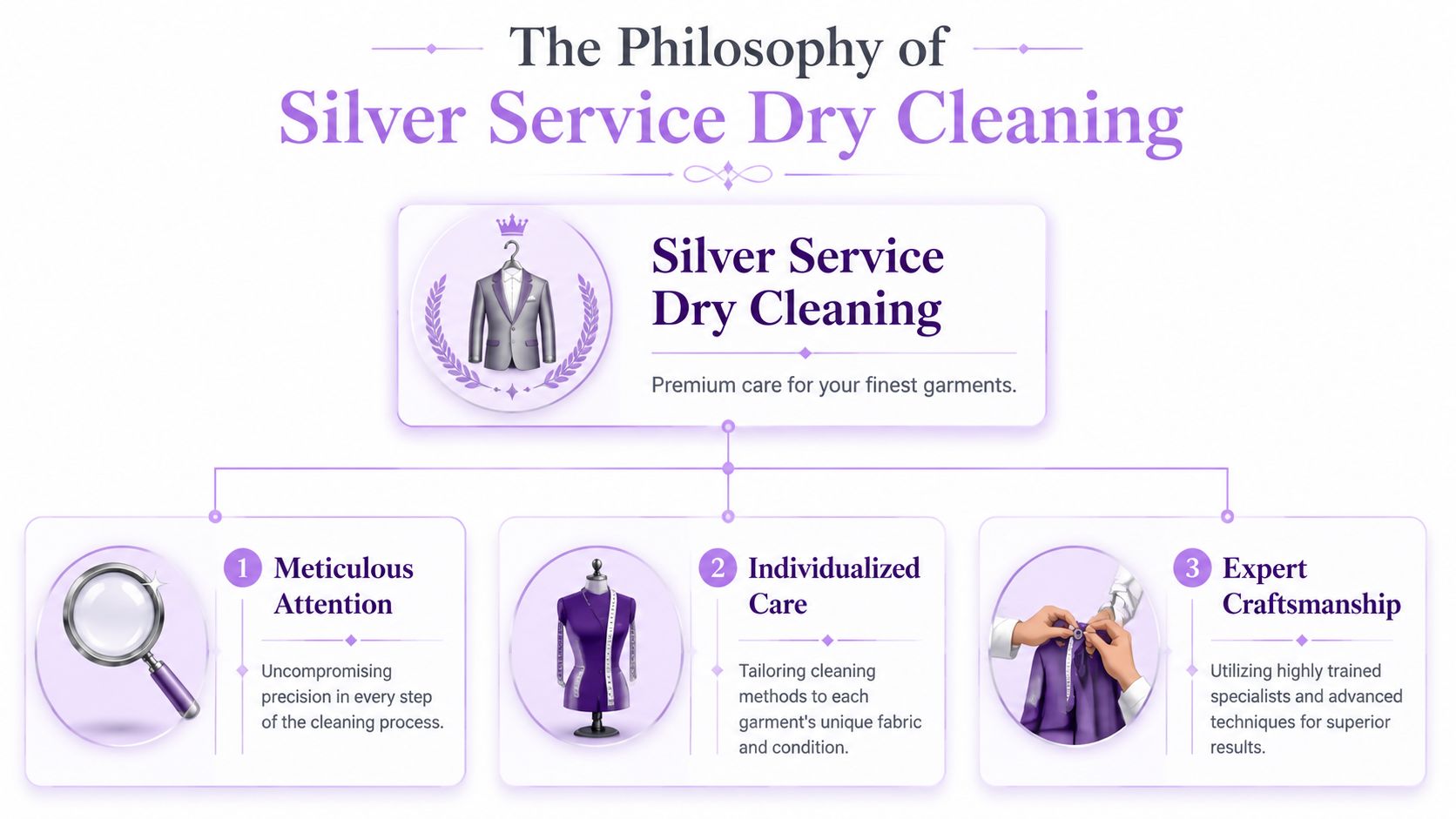
It is a service philosophy, not just a label
Premium protocols described by Shores Fine Dry Cleaning's silver service overview include pre-cleaning garment measurement, button removal or protective covering, and custom cleaning cycles. Those steps explain the higher price. They add labour, judgment, and time at points where garments are most likely to lose shape or suffer trim damage.
A standard service is built for efficiency across many items. Silver service slows the process down on purpose. It treats a garment more like custom furniture than a plain cotton T-shirt. The cleaner checks how the piece is built, where it is vulnerable, and what needs protection before any solvent or steam is used.
Here is where the extra value usually comes from:
- Pre-measurement before cleaning gives the cleaner a reference point, so sleeve length, body width, or trouser drape can be checked after treatment.
- Button protection or removal lowers the risk of cracking, scratching, or heat marks on fragile trims.
- Targeted stain pre-treatment matches the spot treatment to the stain and the fibre, instead of using one routine approach for every mark.
- Custom cycle selection adjusts cleaning conditions to the fabric, dye stability, and garment construction.
- Hand finishing shapes the garment section by section, which matters for lapels, pleats, seams, cuffs, and soft-shouldered tailoring.
That list is the reason silver service costs more. You are paying for decisions made before, during, and after cleaning, not for better packaging or a more polished counter experience.
A similar standard of care applies beyond clothing. Anyone comparing treatment methods for household textiles may also find value in Rubber Ducky's rug cleaning expertise, which shows why fibre type, backing, dyes, and structure all affect how safely an item can be cleaned.
Why those extra steps matter
The easiest way to understand silver service is to look at what can go wrong without it. A silk blouse may come back clean but slightly flatter through the collar. A cashmere knit may look fine on the hanger but sit shorter at the hem. A structured jacket may lose its line because the pressing removed creases without restoring shape. Clean is only one part of the result.
Pre-measurement matters because the cleaner is not relying on memory. Button protection matters because trims often fail before the cloth does. Hand finishing matters because a machine press can flatten a garment evenly, while a skilled finisher can restore contour and balance.
That difference is why premium care is often chosen for suiting, silk, linen, cashmere, embellished pieces, and garments with sentimental value. The fabric may be delicate, but construction is usually the bigger risk. Once shape, drape, or surface finish is lost, it is hard to recover fully.
Some clients also want this level of care across the rest of the home, not just in the wardrobe. For a broader view of lower-impact professional options, this guide to eco-friendly cleaning services in Australia is a useful reference.
Silver service, then, means controlled handling at every stage. The premium is tied to specific work you can point to: measuring, protecting, choosing, testing, and hand-finishing with intent.
Standard vs Silver Service A Clear Comparison
Most confusion disappears once the services are placed side by side. Standard cleaning isn't “bad”. It's designed for different priorities. It suits garments that can tolerate routine processing and don't require individual handling at every stage.
Silver service is for garments where the risk of shape loss, finish damage, or detail wear is high enough to justify more labour.
Dry Cleaning Service Tiers Compared
| Feature | Standard Service | Silver Service |
|---|---|---|
| Garment handling | Batch-oriented and more automated | Individually assessed and handled |
| Pre-clean inspection | Basic visual check | Detailed inspection with fabric and trim attention |
| Stain treatment | General pre-spotting where needed | More targeted stain pre-treatment based on fabric and mark type |
| Dimensional control | Limited | Pre-clean measurement and post-clean consistency checks |
| Buttons and trims | Usually left in place | Buttons removed or protected where needed |
| Cleaning cycle | General cycle selection | Custom cleaning cycles for the specific garment |
| Finishing | Standard machine or routine pressing | Hand finishing with closer control over shape |
| Best for | Everyday trousers, simple office wear, lower-risk items | Couture, silk, linen, cashmere, tailoring, heirloom pieces |
| Main value | Efficiency and convenience | Preservation, presentation, and reduced risk |
Some cleaners also talk about a middle tier, often called “Gold Service”. That label varies widely between operators, so clients shouldn't rely on the name alone. One business may use it to mean extra inspection. Another may use it to mean faster turnaround. The safer approach is to ask what steps are included.
When the service name sounds premium but the process sounds generic, the client is paying for wording rather than workmanship.
Premium specialists stand apart because they can describe their process in plain terms. If a provider can explain exactly how they measure, protect trims, treat stains, and finish garments, that's usually a good sign.
What to Expect Pricing and Turnaround Times
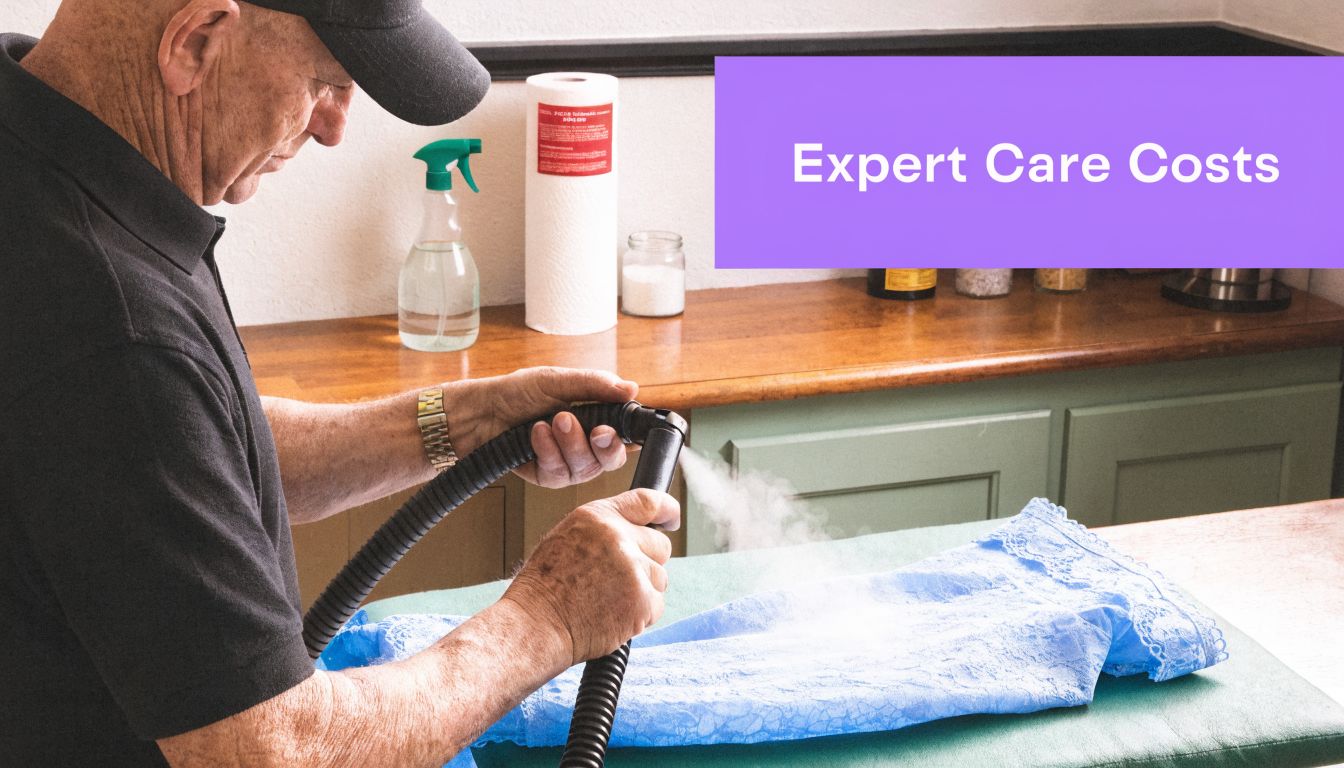
A client brings in two navy jackets on the same morning. One goes through a standard service and comes back clean and presentable. The other goes through silver service and returns with sharper lapels, smoother sleeve lines, better button protection, and a shape that looks closer to the day it was bought. That difference is what the higher price is paying for.
Silver service costs more because more skilled hands touch the garment, and each step takes longer. A standard clean is built for efficiency. A silver service process is built to reduce risk on pieces that can lose shape, shine, or trim if handled too quickly.
Why the bill is higher
The extra cost makes more sense when you break it into labour, not labels.
A premium cleaner may check measurements before cleaning so the garment can be compared again after processing. They may shield or remove fragile buttons, test stain treatment more carefully, select a gentler cycle, and finish the piece by hand instead of relying on a routine press. Hand-finishing matters because it lets the presser restore lines and balance with much finer control. On a structured jacket, that can mean the difference between a flat-looking result and one that still has chest shape, roll, and clean edges.
It works like furniture restoration versus a quick polish. Both can make the item look better. Only one is designed to preserve structure.
That is why silver service is often the right choice for silk, cashmere, linen tailoring, beaded garments, formalwear, and sentimental pieces. The price is not only about cleaning. It is about lowering the chance of avoidable damage and improving how the garment looks when it comes back on the hanger.
Readers who want a broader look at scheduling, quoting, and the usual professional process can read this guide to how cleaning services work in Australia.
Why turnaround can still be fast
Higher care does not always mean a long delay. A well-run premium cleaner can move garments through inspection, cleaning, and finishing quickly if the workflow is organised for careful handling from the start.
The better question is not, "How fast is it?" It is, "What happens to my garment during that time?"
Some items can be turned around quickly because they are stable fabrics with simple construction. Others need more patience. A structured coat, wedding dress, or heavily trimmed piece may need extra drying time, slower finishing, or a second quality check before release. Those pauses are not inefficiency. They are part of protecting the garment.
For broader household care needs, clients do not always need silver service dry cleaning for every item. Everyday garments, linens, and general fabric care can often be handled well by a vetted home specialist or a reliable standard cleaner, while premium garment care is reserved for the pieces where precision pays off. That split approach usually gives the best value.
How to Choose the Right Garment Care Provider
You bring in a wool blazer that fits perfectly through the shoulders, or a silk dress with a fragile covered button at the neck. At that point, the right question is not who can clean it. The better question is who has a process that protects the shape, finish, and weak points of the garment from the moment it reaches the counter.
A premium label means very little on its own. What matters is whether the cleaner can explain, in plain language, what they do differently and why those steps reduce risk. A good provider should be able to walk you through the process the way a skilled tailor explains a fitting.
Questions worth asking before handing over a garment
Two minutes of careful questions can tell you a great deal.
- What steps are included in your silver service? Look for specifics such as stain assessment, fabric testing, pre-measurement, hand-finishing, or a second inspection before pickup.
- Do you measure or check the garment before cleaning? Pre-measurement matters for structured jackets, pleated skirts, and pieces that can lose shape. It works like marking a reference point before careful repair work.
- How do you protect trims, buttons, linings, and embellishments? This shows whether the cleaner notices the parts that fail first.
- Is finishing done by machine, by hand, or both? Hand-finishing is one of the clearest reasons silver service costs more. It takes more skill and more time, especially on lapels, sleeves, cuffs, and shaped dresses.
- How do you handle uncertain stains or fibres? A careful answer should include testing, staged treatment, or a clear explanation of risk.
- Who decides whether an item should stay in standard service or move to premium care? Good judgement matters. A trustworthy provider does not push every garment into the highest-priced option.
Listen for calm, precise answers. If the explanation stays vague, the process may be vague too.
What a strong provider usually offers
A strong garment care provider tends to describe the job in stages. First comes inspection. Then stain spotting and fabric assessment. Then cleaning. Then finishing, reshaping, and final quality control. That sequence matters because expensive mistakes often happen when one of those stages is rushed or skipped.
This is also where the higher price of silver service starts to make sense. You are paying for labour that is harder to standardise. Hand-finishing a finely crafted jacket is closer to pressing with judgement than running a shirt through a routine cycle. Pre-measuring a garment before cleaning gives the team a reference if the fabric relaxes or shifts. Extra inspection catches a loose hem, softened interfacing, or a button that should be protected before processing.
The same principle applies at home. Not every fabric problem requires premium garment care, but it does require the right specialist. For broader household needs such as upholstery, bedding, curtains, or recurring dust issues, a vetted home cleaner can be the more practical choice. Readers comparing garment care with wider fabric hygiene may find this guide to allergy-friendly cleaning for the home useful.
Delicate accessories deserve the same level of thought. Scarves and ties are small, but their fibres can be unforgiving if handled roughly. This guide on properly caring for silk neckwear is a helpful reference if part of your wardrobe care extends beyond jackets and dresses.
A reliable provider usually sounds measured, specific, and realistic. That is often a better sign than grand promises.
The Final Polish When to Use Silver Service
Silver service makes the most sense when the garment would be difficult to replace, expensive to alter again, or easy to damage with generic processing. It isn't necessary for every shirt, skirt, or pair of trousers. It is valuable when the garment requires heightened attention.
A simple decision guide helps:
- Choose silver service for couture, silk, cashmere, linen, structured tailoring, heirloom items, and garments with delicate buttons or trims.
- Choose standard service for routine workwear, simple trousers, and lower-risk everyday garments that don't rely on precise shaping.
- Pause and ask questions for anything with mixed fabrics, unusual construction, embellishment, or sentimental value.
For accessories, the same principle applies. Delicate silk pieces benefit from fibre-aware handling and careful storage. Anyone maintaining scarves or ties may find this guide on properly caring for silk neckwear helpful.
Household fabric care also deserves the same level of thought. Carpets, upholstery, curtains, and bedding can affect comfort as much as clothing does, particularly in homes managing dust sensitivity. For readers exploring healthier cleaning routines beyond garment care, this resource on allergy-friendly cleaning is worth keeping handy.
When a garment needs preservation rather than mere cleaning, silver service dry cleaners earn their place. The added cost pays for control, craft, and fewer compromises.
For households and businesses that need dependable cleaning support beyond garment care, Star Cleaner Australia Pty Ltd offers access to vetted, insured, safety-checked operators backed by a 100% satisfaction guarantee. It's a practical option for regular home cleaning, specialised residential and commercial work, and eco-conscious product support through the Star Cleaner Shop.