


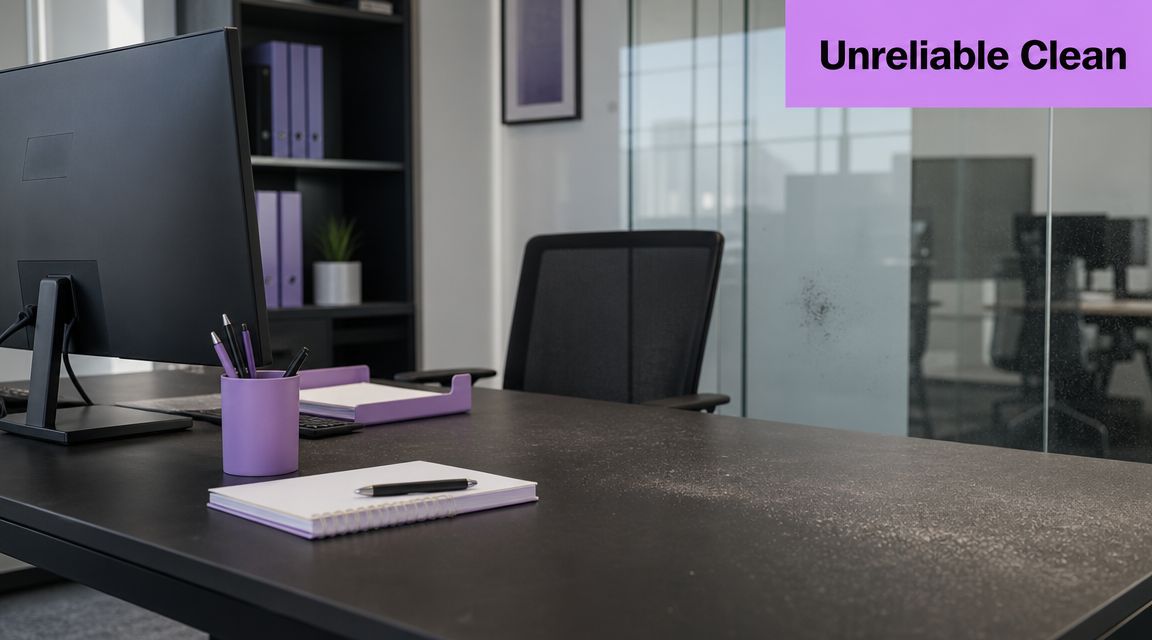
A Melbourne office usually knows when the cleaning contract isn't working before anyone says it out loud. Meeting room tables feel dusty by mid-morning. Kitchen bins fill too early. Toilets look acceptable at a glance but don't hold up through the day. Then the complaints start arriving from staff, visitors, or building management.
That's why office cleaning melbourne shouldn't be treated as a simple commodity purchase. The actual cost of the wrong provider isn't just a poor finish. It's missed shifts, unclear accountability, compliance exposure, avoidable hygiene issues, and a facilities team wasting time chasing basic standards instead of managing the workplace properly.
Table of Contents
- Finding the Right Office Cleaning Partner in Melbourne
- Understanding Your Office Cleaning Scope and Schedule
- How Office Cleaning Prices Are Calculated in Melbourne
- Beyond the Basics Specialised Office Cleaning Services
- How to Evaluate and Onboard Your Cleaning Provider
- Choosing a Partner for a Consistently Clean Melbourne Office
- Melbourne Office Cleaning FAQs
Finding the Right Office Cleaning Partner in Melbourne
A common procurement mistake is to replace one underperforming cleaner with another based on speed and price alone. The new contractor promises better communication, sharper presentation, and tighter supervision. A few weeks later, the same problems return. Consumables are missed, detail work slips, and no one seems fully responsible for fixing issues.
That pattern makes sense in a crowded market. Australia's commercial cleaning industry comprises over 44,000 businesses, and the sector grew by 4.7% annually between 2020 and 2025 according to IBISWorld industry reporting. For Melbourne buyers, that means choice isn't the problem. Filtering out risky operators is.
What a reliable partner looks like
A proper cleaning partner does more than send a person with a mop. The provider should be able to define scope, allocate suitable labour, manage absences, document issues, and keep standards consistent across ordinary weeks and difficult ones.
The practical difference usually shows up in five places:
- Attendance reliability: Someone turns up when scheduled, with a backup plan if they can't.
- Site familiarity: The cleaner knows the tenancy layout, access rules, alarm procedures, and waste flow.
- Quality control: The provider checks work instead of waiting for complaints.
- Safety discipline: Chemicals, equipment, and procedures are managed sensibly.
- Clear accountability: One contact owns the outcome.
Practical rule: Buy the system behind the cleaner, not just the cleaner.
Melbourne offices that want fewer operational headaches often end up preferring providers with structured commercial cleaning services rather than loosely managed subcontract arrangements. That doesn't guarantee quality on its own, but it usually gives facilities teams a clearer line of control when something needs attention.
Understanding Your Office Cleaning Scope and Schedule
Most office cleaning disputes start with a weak scope. One side assumes “general cleaning” includes detailed desk wiping, internal glass, and proper kitchen sanitising. The other assumes it means empty bins, vacuum, and a quick once-over. If those assumptions aren't written down, the contract starts drifting from day one.
What belongs in the base scope
A sound office cleaning scope separates presentation tasks from hygiene tasks and separates routine work from periodic work. That matters because labour, dwell time, equipment, and chemicals differ depending on the surface and the risk.
Core items usually include:
- Workstations and surfaces: Dust removal, visible soil removal, and tidy presentation.
- Amenities and washrooms: Toilets, sinks, mirrors, fittings, floors, and restocking arrangements if agreed.
- Kitchen and breakout areas: Benches, sinks, appliance exteriors, splashbacks, bins, and floor care.
- Floors throughout the tenancy: Vacuuming, spot mopping, or full mopping depending on floor type and traffic.
- Common touchpoints: Doors, handles, switches, and shared equipment.
Melbourne buyers who want a useful reference point can review how cleaning services work in Australia before drafting their own scope. The goal isn't to copy another site's checklist. It's to make sure nothing important has been left vague.
Typical Office Cleaning Schedules at a Glance
A Melbourne office cleaning schedule should match the way the office is used. A lightly occupied consulting suite doesn't need the same frequency as a busy open-plan tenancy with shared desks, heavy meeting room turnover, and a full kitchen.
| Task | Daily | Weekly | Monthly/Quarterly |
|---|---|---|---|
| Empty bins and replace liners | Yes | As needed | No |
| Vacuum and mop floors | Yes | As needed for detail edges | No |
| Clean toilets and sinks | Yes | Deep detail as required | No |
| Wipe desks and visible surfaces | Yes | Detailed edge work | No |
| Clean keyboards, phones, and shared tech | Yes | Detail check | No |
| Spot clean internal glass | As needed | Yes | No |
| Chair bases and detailed furniture cleaning | No | No | Monthly |
| Carpet steam cleaning | No | No | Quarterly |
| Hard floor re-sealing or restorative floor work | No | No | Quarterly |
A published Melbourne schedule notes daily cleaning for desks, keyboards, phones and shared tech, vacuuming and mopping, and disinfecting toilets and sinks, with deeper items such as chair-base cleaning monthly and carpet steam cleaning or hard-floor re-sealing quarterly in this office cleaning inclusion guide. The same guidance also notes that WorkSafe Victoria expects MSDS to be kept for hazardous chemicals and encourages less hazardous alternatives where possible.
High-touch hygiene is its own workstream
Industry guidance for Melbourne offices specifies that desks, keyboards, door handles, light switches, and shared equipment should be sanitised regularly in this Melbourne office cleaning standards guide. That point matters because high-touch disinfection shouldn't be buried inside a vague line item like “dust and wipe surfaces”.
A better scope names touchpoint sanitising as a distinct requirement, especially for:
- Shared desks and hot desks
- Boardrooms and meeting rooms
- Printer zones and utility points
- Reception counters and entry hardware
High-touch cleaning needs its own checklist, because visual cleanliness and hygienic cleanliness aren't the same thing.
If the office has hybrid occupancy, ask the provider how they'll handle variable desk use. A fixed checklist often misses the actual work pattern. A cleaner should know which rooms turn over most, which spaces stay unused, and where cross-contact risk is highest.
How Office Cleaning Prices Are Calculated in Melbourne
The wrong way to read a cleaning quote is to compare the bottom line only. The useful question is what labour model, scope, supervision, and risk assumptions produced that number.
Office cleaning in Melbourne is typically priced at A$42 to A$65 per hour, with small offices commonly paying A$150 to A$300 for a weekly package and large offices needing daily cleaning often landing around A$900 to A$1,800+, while CBD sites can attract a 10 to 20% premium because of access and parking complexity, according to this Melbourne office cleaning pricing guide.
What a quote is really pricing
A cleaning quote usually reflects a bundle of variables, not just floor area.
These are the main cost drivers:
- Frequency of service: Daily attendance changes labour planning far more than a once-weekly visit.
- Office layout: Multiple kitchens, amenities, stairs, glass partitions, and meeting rooms add time.
- Building access: After-hours access, loading restrictions, lift bookings, and CBD parking all matter.
- Risk profile: Shared equipment, busy amenities, and high visitor traffic increase cleaning intensity.
- Consumables and equipment: Some quotes include them. Others don't.
A well-built quote should tie directly back to the scope and cleaning schedule. If it doesn't, it's hard to hold anyone to account later.
Why a very cheap quote is risky
A low quote can mean efficient scheduling and a realistic site plan. It can also mean corners have already been cut before the contract starts. The buyer won't see that immediately. It usually surfaces later as rushed cleans, poor retention, inconsistent staff, or missing compliance documents.
A quote that looks cheap on paper can become expensive once the facilities team starts spending time on escalations, re-cleans, and complaint handling.
On-site quoting is usually the safest approach because it forces the provider to inspect access points, floor finishes, washroom count, touchpoints, storage space, and any special requirements. Without that visit, the price is often just an estimate dressed up as a commitment.
Beyond the Basics Specialised Office Cleaning Services
Routine office cleaning covers the everyday standard. It doesn't solve every problem a workplace accumulates over time. Sooner or later, most Melbourne offices need targeted work that sits outside the normal nightly or weekly scope.
When standard cleaning isn't enough
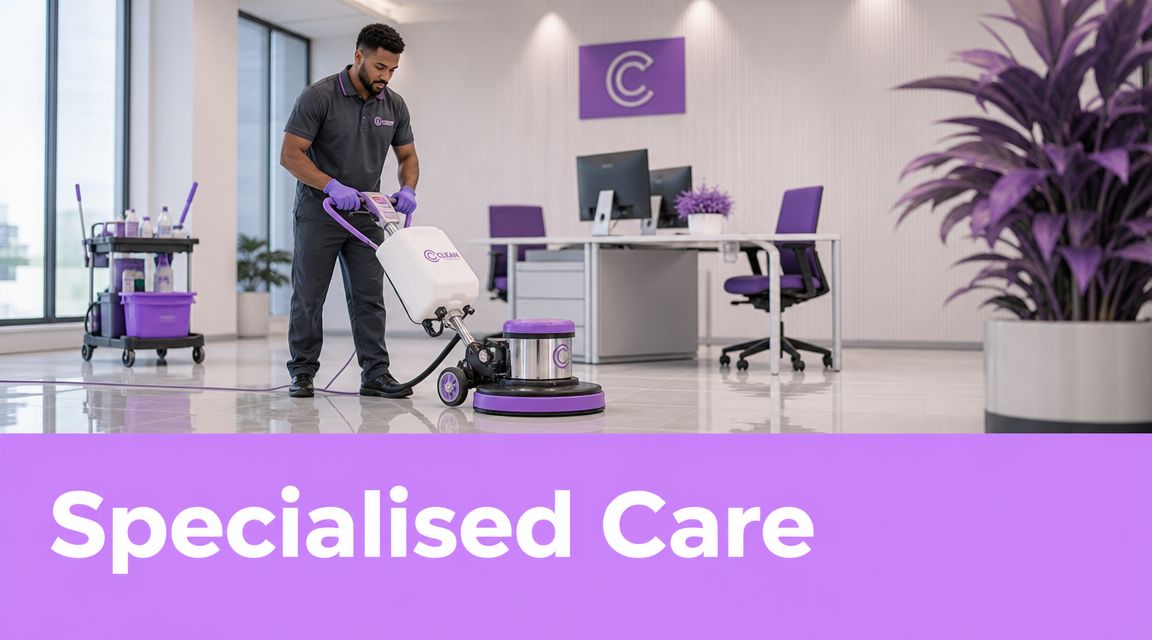
Some issues are obvious. Carpet stains in a client-facing boardroom. Grease build-up around kitchenette splashbacks. Scuffed hard floors near reception. Fine dust after minor fit-out works. These jobs need different methods, different chemistry, or different machinery.
Common specialised add-ons include:
- Carpet steam cleaning: Useful when vacuuming no longer lifts embedded soil or odour.
- Hard floor maintenance: Scrubbing, polishing, or re-sealing where wear has dulled the finish.
- Post-construction or fit-out cleans: Removing settled dust, adhesive residue, and fine debris before occupancy.
- Corporate apartment or short-stay turnovers: A separate service model when businesses manage accommodation stock.
For visible problems like carpet staining or kitchen grease, commercial-grade products matter. Low-quality chemicals often spread the issue, leave residue, or damage finishes. A practical option is to source suitable products from the Star Cleaner Shop eco-friendly cleaning range, especially when the site wants lower-toxicity supplies without shifting to harsh-smelling treatments.
When an office is closing, moving, or downsizing, cleaning often overlaps with furniture removal and waste diversion. In that situation, a resource on eco-friendly office decommissioning can help teams coordinate cleanout work with responsible disposal planning.
Sustainable products and indoor air quality
Post-pandemic workplace expectations changed the cleaning conversation. The Australian Office of the Future report highlights that office cleanliness, hygiene confidence, and indoor air quality have become important to tenant experience and employee retention, as noted in this industry summary.
That's why “green cleaning” shouldn't be treated as branding language alone. The practical test is whether the provider can explain product selection, residue control, odour impact, and safe use around occupied spaces.
A useful distinction is this:
| Need | What works | What doesn't |
|---|---|---|
| Sensitive occupied areas | Low-toxicity products with clear usage procedures | Strong-smelling chemicals used without reason |
| Floor finish protection | Chemistry matched to surface type | One product used on every floor |
| Breakout and food areas | Food-safe cleaning approach and residue control | Over-application that leaves benches tacky |
| Spot problems | Targeted treatment | Repeated aggressive cleaning that damages surfaces |
How to Evaluate and Onboard Your Cleaning Provider
Most buyers ask for references and a price. Too few ask for the documents and processes that reduce risk. That gap matters because office cleaning sits inside a high-compliance operating environment, and the consequences of poor vendor selection usually land on the client as well.
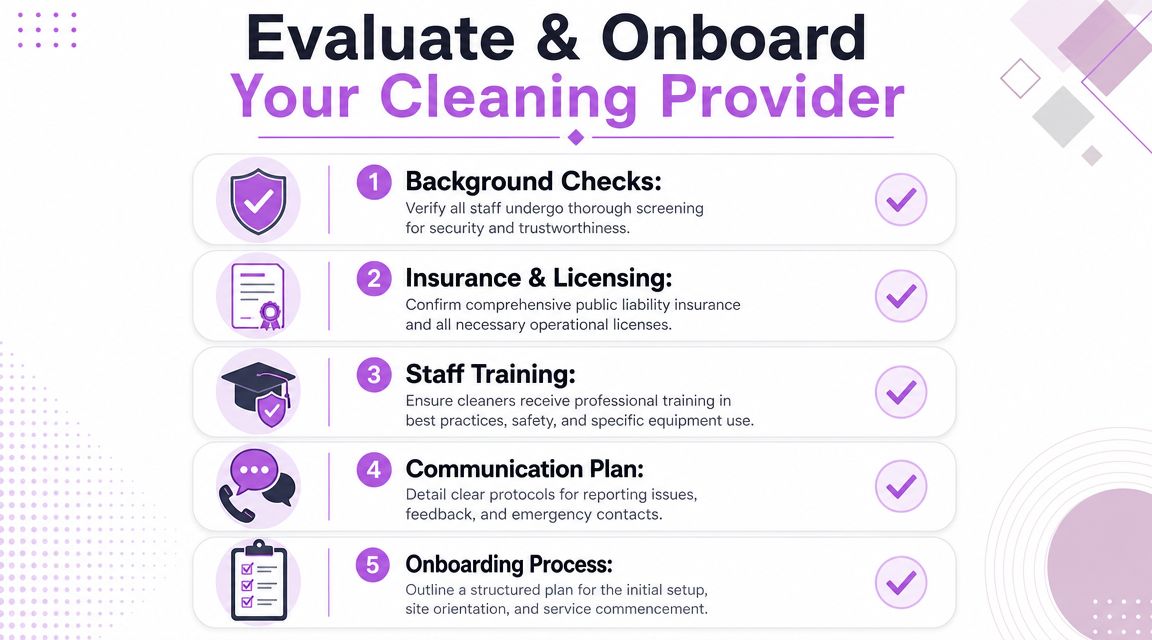
A major gap in typical buying advice is how to verify a cleaner's compliance with Fair Work and WHS obligations. In Australia's high-compliance cleaning sector, failing to check proper insurance, police clearances, and legal pay rates exposes a business to liability and service disruption risks, according to this guidance on compliance risks in office cleaning.
The non-negotiable checks before signing
A serious procurement review should include these checks before the contract is approved:
- Insurance evidence: Ask for current public liability documentation and confirm it matches the type of work being quoted.
- Police clearances and screening: This is especially important for tenancies with after-hours access, confidential material, or vulnerable occupants.
- WHS procedures: The provider should be able to explain incident reporting, chemical handling, manual handling, and equipment safety.
- Pay and engagement model: The buyer doesn't need payroll records on day one, but they should test whether the business understands legal engagement and record-keeping obligations.
- Staff continuity plan: Ask what happens if the regular cleaner is sick, leaves, or loses site access.
Not every office needs the same documents, but every office needs proof that the provider runs a real operating system.
What good onboarding looks like
The contract starts working before the first clean. That's why onboarding matters. A rushed start creates avoidable confusion around access, priorities, defects, and responsibilities.
A practical onboarding process includes:
Site walk-through with the actual scope
The cleaner or supervisor should review the areas line by line, not rely on a sales summary.Key standards written down
Define what “done properly” means for kitchens, amenities, floors, and touchpoints.Access and security controls
Alarm codes, sign-in procedure, restricted rooms, and after-hours contact details need clear handling.Defect reporting method
If the cleaner sees a leaking tap, damaged dispenser, or stained carpet tile, someone should hear about it promptly.Review period after commencement
The first weeks should include structured feedback so issues are corrected before they become routine.
Cleaners don't create consistency by goodwill alone. Managers create it with clear standards, documentation, and follow-up.
Within that model, providers such as Star Cleaner Australia are relevant because they connect businesses with vetted, insured operators, support scheduled service delivery, and back the work with a 100% satisfaction guarantee. For procurement teams, that kind of structure matters more than polished sales language because it reduces dependency on one individual and improves service continuity.
Choosing a Partner for a Consistently Clean Melbourne Office
A clean office isn't the result of a cheap quote or a long service list. It's the result of a provider who can deliver the same standard repeatedly, manage risk sensibly, and resolve issues without being chased.
That's the difference between a vendor and a partner. A vendor completes tasks. A partner protects the workplace standard, supports the facilities team, and keeps the contract stable when staffing changes, occupancy shifts, or special jobs appear.
For many Melbourne offices, the best buying decision is the one that removes management friction. That means a clear scope, realistic pricing, verified compliance, safety-checked operators, and a documented onboarding process. Pricing is only one input in that decision. For a full breakdown of how commercial cleaning is typically priced across Australia, including hourly, square-metre and flat-rate models and the factors that drive cost, see our commercial cleaning rates guide. It can help you judge whether a quote reflects genuine value rather than just a low number. Internal behaviours matter too. Offices that want to maintain standards between cleans can adapt practical office clean desk guidelines so cleaners aren't forced to work around cluttered surfaces and unsecured documents.
The right office cleaning melbourne provider should make the workplace easier to run, with clear communication and consistent hygiene standards day to day. If the facilities team is still constantly following up, the contract isn't doing its job.
Melbourne Office Cleaning FAQs
What happens if the regular cleaner is absent
This should be answered before the contract is signed. A reliable provider needs backup coverage, not an apology after the missed shift. Ask who replaces the cleaner, how site knowledge is handed over, and who checks the substitute's work on the first visit.
Who supplies chemicals, equipment, and consumables
It depends on the agreement, so it needs to be explicit in writing. Some contracts include equipment and chemicals but treat consumables separately. Others bundle more into the service. The risk isn't just cost confusion. It's stock outages, incompatible products, and no one taking ownership.
Is green cleaning more expensive
Sometimes it can affect product selection, but the better question is whether the specification is sensible. Lower-toxicity products, controlled chemical use, and suitable methods can support indoor comfort without compromising standards. The cost discussion should sit inside the full scope, not as a standalone add-on.
How often should an office be cleaned
That depends on occupancy pattern, tenancy layout, shared areas, and hygiene expectations. A lightly used office may suit a lower frequency schedule. A busy workplace with shared desks, multiple meeting rooms, and heavily used amenities usually needs more frequent attention.
Should the contract include periodic deep cleaning
Yes, if the office has carpets, hard floors, upholstered seating, or high-use kitchens and amenities. Routine cleaning maintains the daily standard. Periodic works restore surfaces and deal with gradual soil build-up that ordinary visits won't fully remove.
What's the biggest mistake buyers make
Treating cleaning as a generic line item. When scope is vague and vetting is weak, the buyer often ends up managing the contractor instead of managing the workplace. A strong contract gives the provider a clear standard to deliver and gives the client a clear basis for accountability.
For Melbourne businesses that want reliable scheduled cleaning without the usual gaps, Star Cleaner Australia Pty Ltd offers access to vetted, insured, safety-checked operators, structured service management, and a 100% satisfaction guarantee. That's useful for offices that need consistency, clear communication, and less day-to-day chasing of basic standards.
Star Cleaner also serves commercial clients outside Melbourne — if your business is in Sydney CBD, our commercial cleaning Sydney CBD page covers building access, after-hours scheduling, and high-rise office cleaning specific to that area.