


A revolving door of cleaners, resident complaints about dusty ledges, and confusing quotes for "basic" services can wear down even organised strata teams. For strata managers and committees, the problem usually isn't finding a cleaner. It's finding one that turns up consistently, follows site rules, reports issues properly, and doesn't leave grey areas in the contract.
That matters because strata cleaning sits at the centre of property presentation, resident safety, and day-to-day compliance. In Australia, the service scope typically covers shared areas such as corridors, vestibules, elevators, garbage rooms, exterior spaces, and gardens, with many buildings needing weekly or fortnightly service cycles to keep standards consistent, as outlined by Synergy Four Services on strata cleaning scope. This guide compares seven well-known strata cleaning companies and focuses on what committees need to judge: reliability, supervision, reporting, flexibility, and contract fit.
Table of Contents
- 1. Star Cleaner Australia Pty Ltd
- 2. Clean Group
- 3. AMC Commercial Cleaning
- 4. Jani-King Australia
- 5. Cleanworks Australia
- 6. Pro Clean Corp
- 7. KV Cleaning Group
- Top 7 Strata Cleaning Companies Comparison
- Building a Partnership for a Cleaner, Safer Community
1. Star Cleaner Australia Pty Ltd
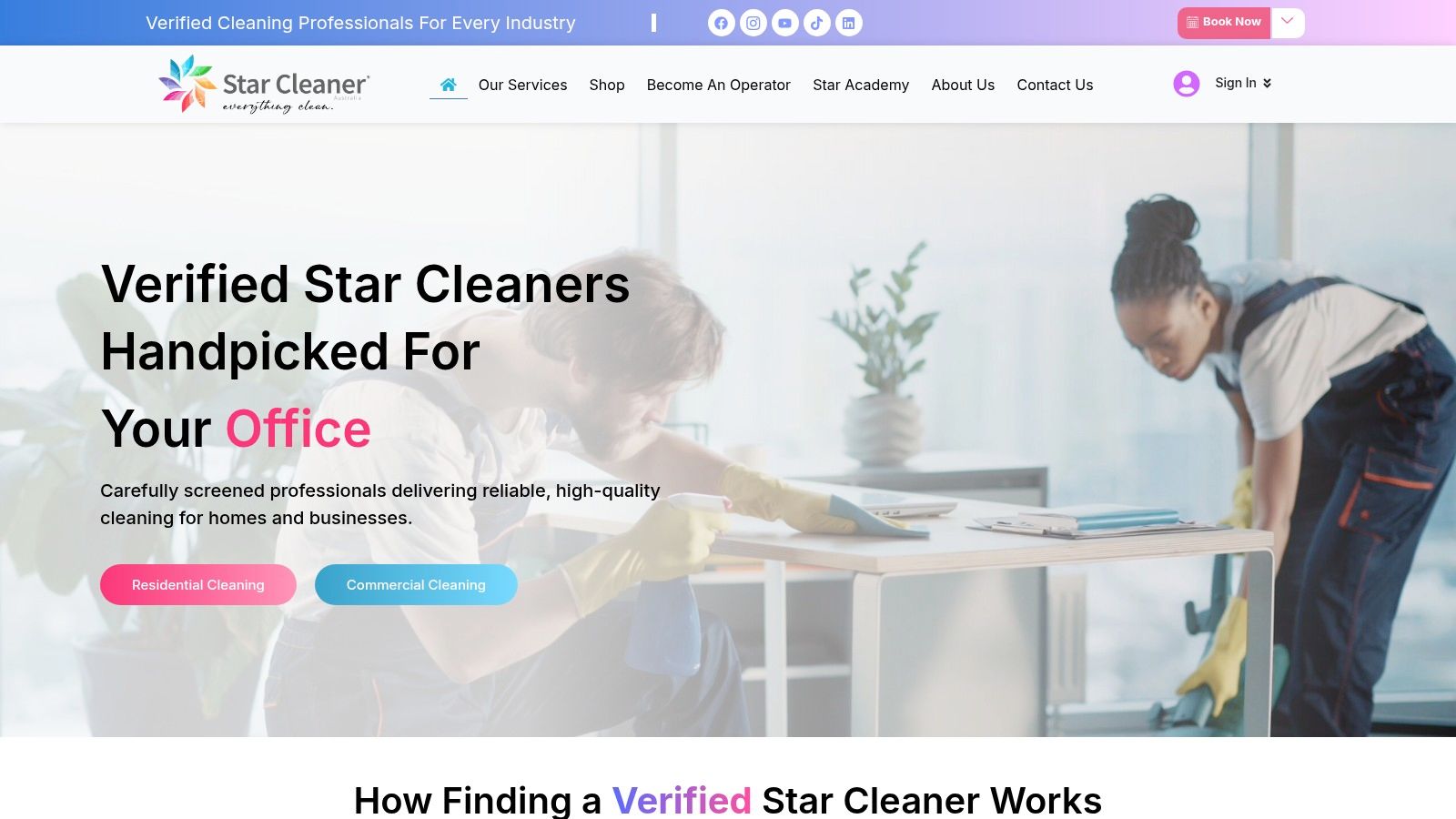
A familiar strata problem starts the same way. The building looks acceptable for the first two visits, then missed corners show up in stairwells, bin room odours linger, and no one can confirm who attended the site that week. For committees trying to reduce complaints and keep records in order, Star Cleaner Australia Pty Ltd stands out because its model addresses delivery control, not just labour supply.
The company uses on-site quoting, matches cleaners to the work required, and offers recurring or one-off service schedules. That structure matters in strata where common property rarely fits a generic checklist. Entry glass, lift interiors, car parks, rubbish areas, shared bathrooms, and weather-exposed walkways all need different frequencies, equipment, and inspection standards. A useful reference point is Star Cleaner Australia's explanation of how professional cleaning services are typically scoped and delivered in Australia.
Why it stands out
The practical advantage is coverage across more of the cleaning chain. Star Cleaner combines service delivery with operator vetting, training support, and access to commercial supplies. For a strata manager, that can reduce one of the common gaps in contract performance. The cleaner arrives, but the site-specific method, product choice, or relief coverage is inconsistent.
Quality control is where this provider is worth close attention. Star Cleaner publishes booking and cancellation terms, refers to safety-checked operators, and offers trial cleans before a longer commitment. That gives committees a low-risk way to test punctuality, presentation standards, communication, and attention to detail before locking in a recurring scope.
Practical rule: Ask every strata cleaning company to show how it handles absences, complaints, and site handovers. If those steps are vague, the contract risk sits with the owners corporation.
Another point in Star Cleaner's favour is operating depth. The business states that it is built on long industry experience and works with a large verified cleaner network across Australia. Scale alone does not guarantee better cleaning, but it does help with continuity when a regular operator is unavailable or when a manager oversees multiple sites with different service needs.
Best fit
Star Cleaner Australia suits strata managers and committees that want a provider with documented processes behind the quote. It is a better fit for buildings that care about service consistency, contractor accountability, and a clear path for rectification if standards slip.
The trade-off is straightforward. Pricing is not set out as a flat online rate, so committees looking for an instant like-for-like comparison will need to spend time on a site inspection and scope review. In practice, that is often the better approach for strata. It reduces disputes over extras and makes it easier to check whether high-risk areas such as lifts, waste rooms, touchpoints, and access-controlled spaces are included.
For committees vetting providers, use this listing as a prompt to ask harder questions before signing. Confirm who supervises the work, how consumables are handled, what response time applies to complaints, and whether trial periods or satisfaction remedies are written into the agreement. Those details usually matter more than a low starting price.
2. Clean Group
Clean Group is a Sydney-focused option that suits committees wanting documented systems and a compliance-oriented presentation. Its strata service material is clear about the areas it handles, including common areas, lobbies, lifts, car parks, and amenities, with add-ons such as carpet cleaning, window cleaning, and disinfection.
The practical value here is the quoting process. Clean Group offers free on-site quotes, which helps avoid one of the most common contract problems in strata cleaning companies: a scope that looks affordable until the first extra invoice appears. If the site has glass balustrades, high-touch lift surfaces, or weather-exposed entries, that detail should be captured before commencement, not argued over later.
Where it fits best
Clean Group's triple ISO accreditation in quality, environmental, and safety management will appeal to owners corporations that need documented process maturity. That won't automatically guarantee better day-to-day cleaning, but it does give committees a stronger paper trail when they need contractor records, procedures, or evidence of structured management.
For buildings comparing Sydney providers, it can help to review the expected workflow against a broader commercial cleaning service model used by Star Cleaner Australia. That makes it easier to assess whether the provider is offering routine attendance only, or a fuller service structure with clearer accountability.
A good strata quote names the exact surfaces, frequencies, consumables, exclusions, and response process for complaints. If those details are missing, the hourly rate doesn't mean much.
The main limitation is geographic concentration. Clean Group appears most directly positioned for Sydney on its strata page, so committees with interstate portfolios may need a second provider or a separate management approach. For single-city schemes that care about formal systems, it's a credible contender.
3. AMC Commercial Cleaning

AMC Commercial Cleaning sits in a different category from niche strata specialists. It is a large Australian-owned commercial cleaner with a broad service footprint, which makes it more relevant for managers handling multi-site portfolios than for a single committee wanting a highly customized local operator.
The company states it was established in 1988 and has more than 2,500 staff across Australia and New Zealand. That scale can be a real advantage when a portfolio needs broader coverage, relief support, or standardisation across different property types. It can also mean strata cleaning is folded into a wider commercial delivery model rather than treated as a dedicated specialist line.
What to confirm before signing
The key issue isn't capability. It's specificity. AMC doesn't foreground a dedicated public strata page in the same way some competitors do, so committees should ask direct questions during tendering. Who supervises common-area presentation? How are defect reports handled? What reporting is available for missed cleans, consumables, or hazards in bin stores and stairwells?
Those questions matter because strata contracts work differently from standard office cleaning. Shared residential environments involve access constraints, resident sensitivity, body corporate rules, and a stronger need for visible consistency. Committees unfamiliar with outsourced cleaning can review a simple explanation of how cleaning services work in Australia through Star Cleaner Australia before briefing larger providers.
A point in AMC's favour is organisational depth. Large providers often have stronger backup arrangements, broader procurement ability, and more established administrative systems. The trade-off is that committees may need to work harder upfront to make sure the site specification is detailed enough and that strata-specific standards don't get buried inside a generic commercial contract.
4. Jani-King Australia
A committee approves a national provider expecting consistency across every foyer, lift, and bin room. Three months later, one building is spotless and another is drawing resident complaints. That is the core issue with franchise-based strata cleaning. The brand can be strong, but day-to-day delivery still depends on the local operator.
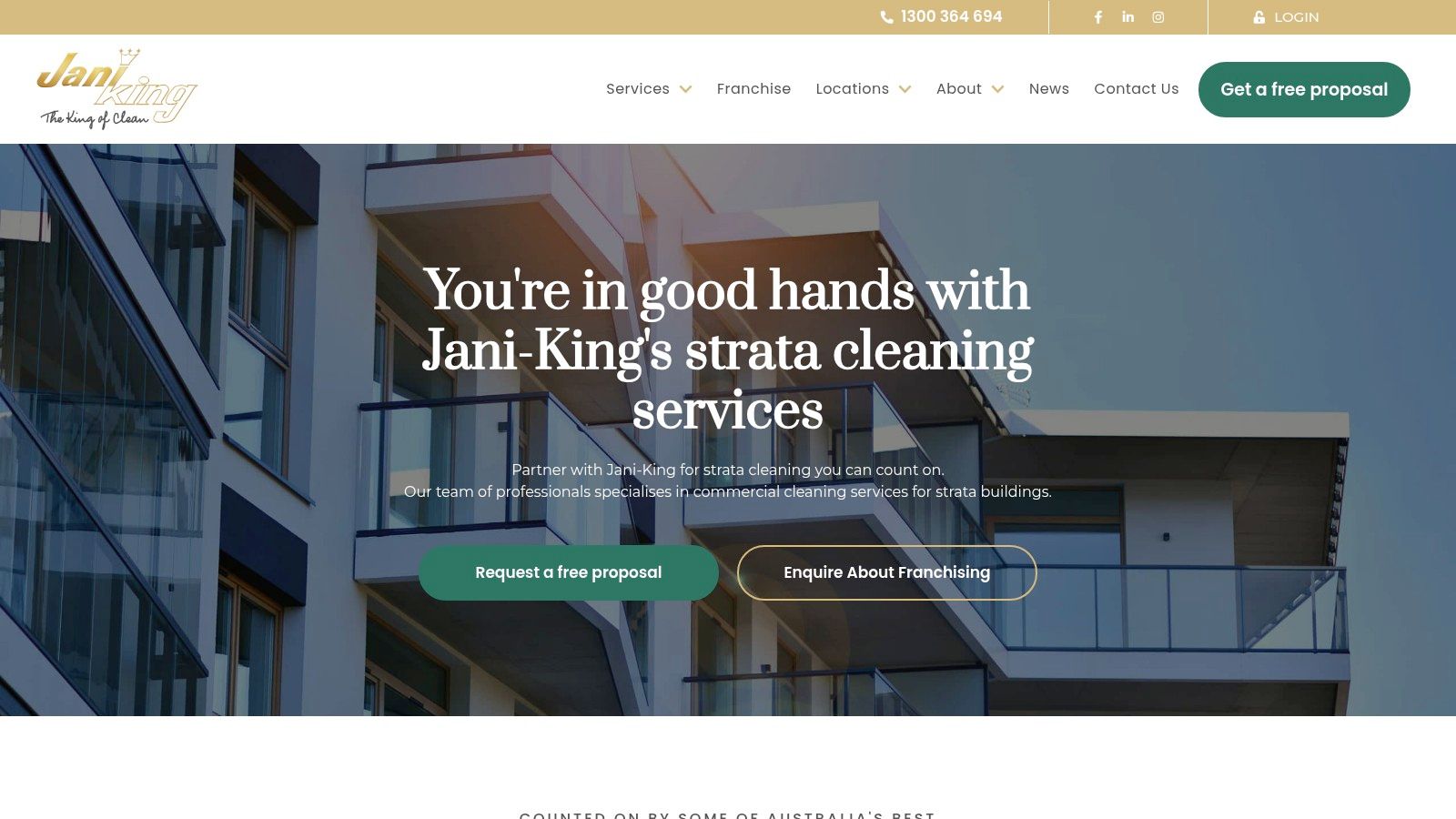
Jani-King Australia is worth considering for portfolios that want a dedicated strata service supported by a recognised national network. For strata managers handling multiple sites, that structure can make procurement, documentation, and service rollout more orderly than managing several unrelated local contractors.
The primary assessment point is contract control.
Jani-King's model can work well if the scope is written tightly and site supervision is clear from the outset. Ask who the franchisee is for your suburb, who carries out inspections, how relief staff are assigned, and whether the same cleaners will attend each visit. In residential buildings, consistency matters because residents notice small variations fast. Smears in lifts, odour in waste areas, and poorly presented entries generate complaints long before a contractor records them as defects.
This is also where committees should move past a price comparison and test whether the provider can handle building-specific risks. If your scheme has enclosed corridors, asthma-sensitive residents, or recurring dust complaints, ask for product schedules and task methods in writing. It helps to review practical guidance on allergy-friendly cleaning for shared indoor spaces before finalising the specification, especially for buildings with limited ventilation.
Contract red flag: Be cautious if the proposal promises audits and quality checks but does not name the person responsible, the inspection frequency, or how missed items are corrected and logged.
Jani-King is a sensible option where coverage, process, and administrative structure matter. The trade-off is that committees need to vet the local franchise operator with the same care they would apply to an independent contractor. Brand recognition helps. Clear supervision, site-specific scopes, and enforceable reporting matter more.
5. Cleanworks Australia
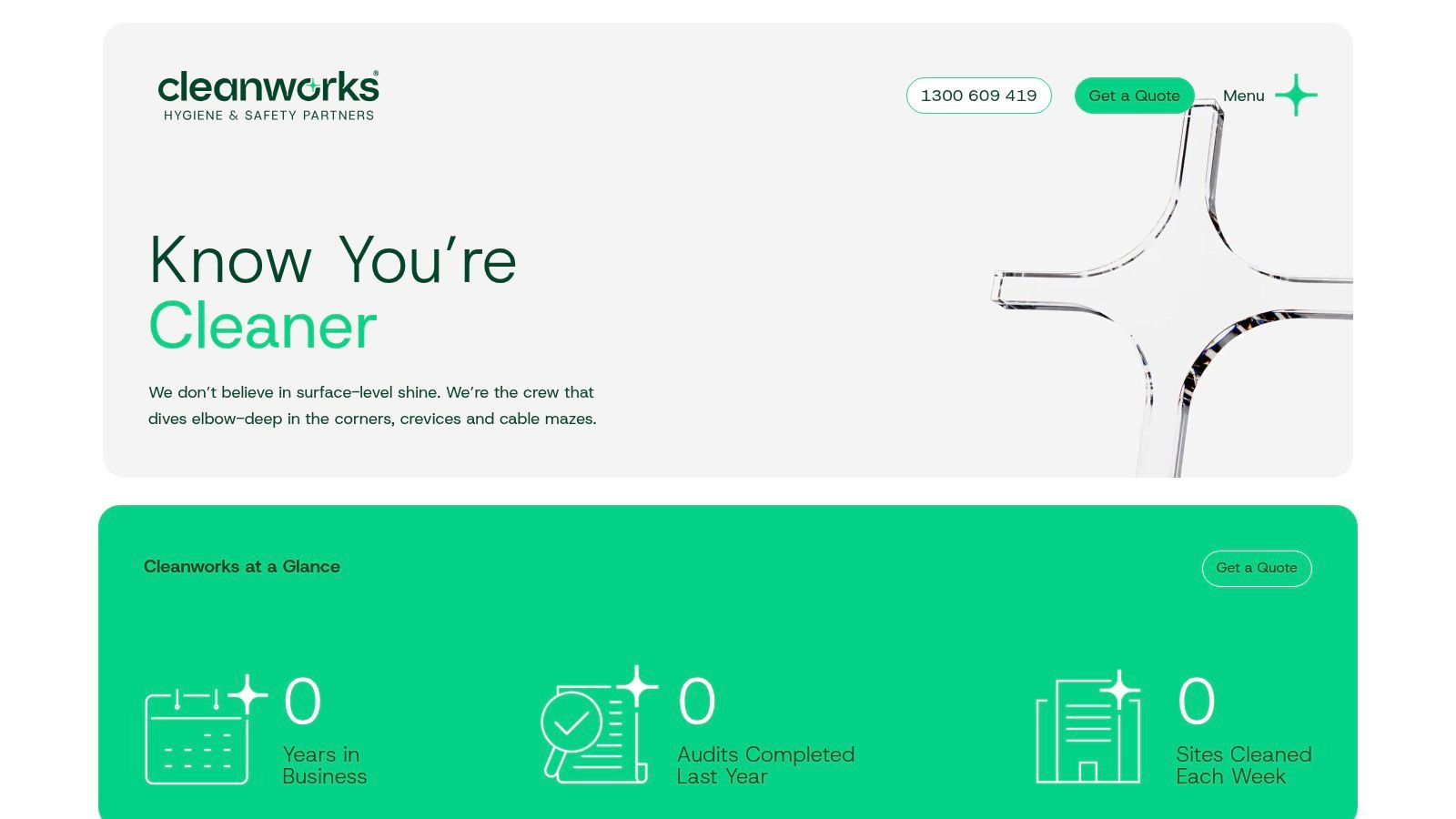
Cleanworks Australia will appeal to committees that want reporting discipline and measurable oversight. The company states that it has been operating for over 23 years, services 600 sites weekly, and completes more than 1,700 audits per year, all published on its website. Those figures suggest a business that is comfortable being judged on operating rhythm rather than marketing language.
That matters in strata because quality problems are often cumulative. Missed corners in stairwells, neglected fingerprints in lifts, and bins that are "done quickly" rather than cleaned properly can slide for months if no one audits the work. A provider with a client portal and visible auditing culture is often easier to manage than one that only promises responsiveness by phone.
Where the reporting matters
Cleanworks also has physical coverage across Queensland, New South Wales, Victoria, and South Australia, which helps portfolios spread across more than one market. The reporting side is where the value becomes clearer. Committees can ask for site-specific audit points tied to the actual problem areas in the building rather than generic pass-fail checks.
For residential schemes where dust, odour, and allergen complaints surface in enclosed common areas, it also helps to compare the provider's methods with practical allergy-friendly cleaning guidance from Star Cleaner Australia. That's especially useful when committees are reviewing chemical use, ventilation-sensitive spaces, and resident comfort.
Cleanworks isn't a strata-only operator, so mobilisation matters. Committees should insist on a building-specific scope with defined frequencies, complaint handling, and evidence of attendance. If that tailoring is done well, Cleanworks can be a strong choice for data-minded owners corporations.
6. Pro Clean Corp
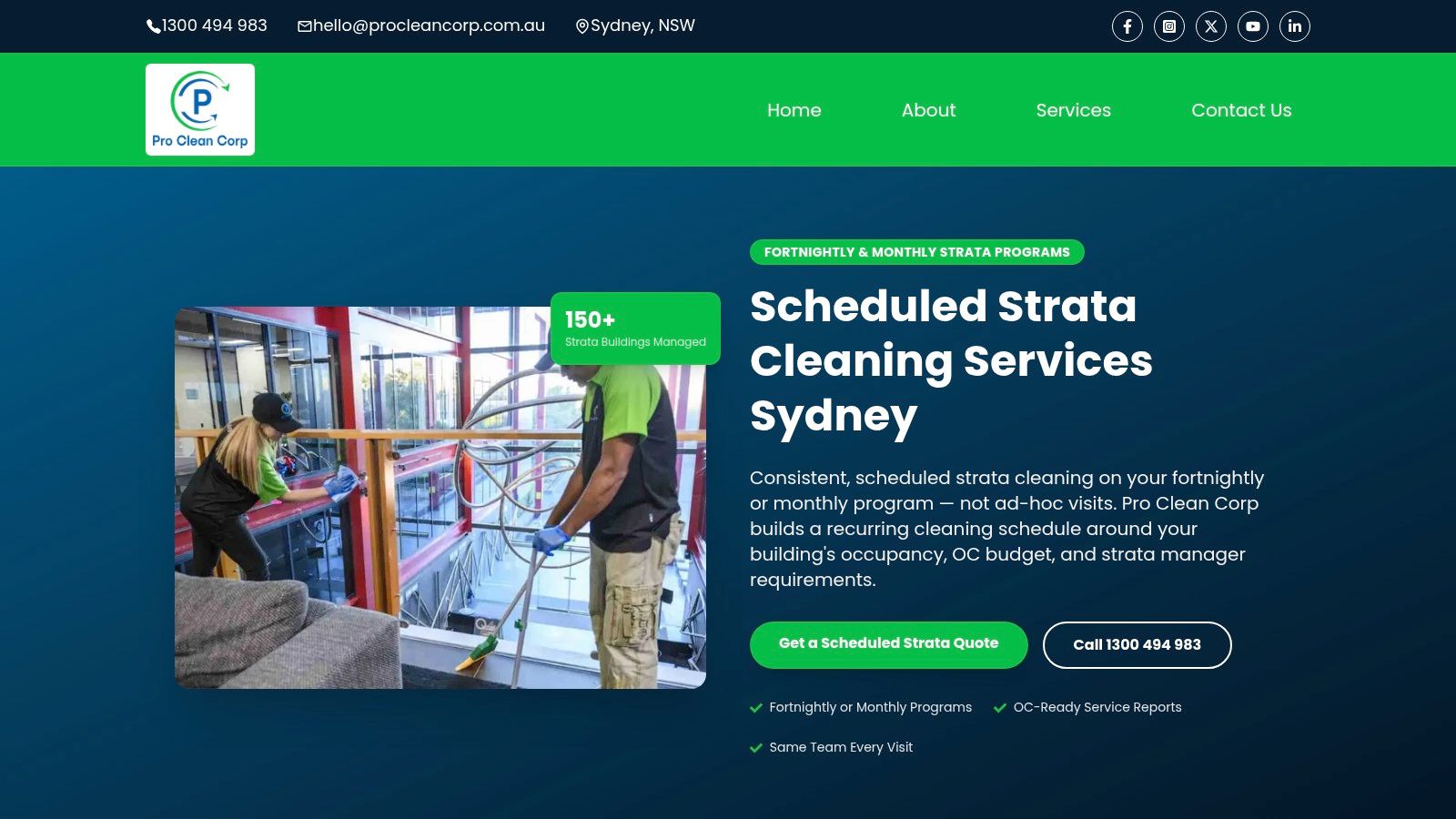
Pro Clean Corp is a Sydney-based strata and body corporate specialist that takes a more flexible, manager-facing approach than many larger operators. Its offering is built around direct engagement with strata managers and owners corporations, which can make decisions and adjustments faster when a building's needs change.
That style suits committees that don't want to be trapped in a rigid contract while they work out the right service level. Some buildings need a stable routine. Others need regular cleaning plus occasional bursts of attention after moves, renovations, storms, or seasonal mess around entrances and car parks.
Why flexibility matters
Pro Clean Corp highlights no lock-in terms and adjustable service frequency. For committees that have been stuck with underperforming contracts, that lowers the switching risk. It also creates room to test a provider on practical outcomes such as presentation, communication, and follow-through before extending the arrangement.
The caution is scale. A Sydney-only orientation can be a strength for local supervision, but it won't help national portfolios that need one provider across several states. Smaller regional focus can also mean less depth for large-site backup if several issues land at once.
A useful way to assess providers like this is to ask for examples of how they handle event cleans, wet-weather adjustments, and post-renovation resets inside an ongoing schedule. In strata, flexibility only has value when the company can still maintain baseline standards every week. If the operator can do both, a local specialist often outperforms a larger provider on responsiveness.
7. KV Cleaning Group
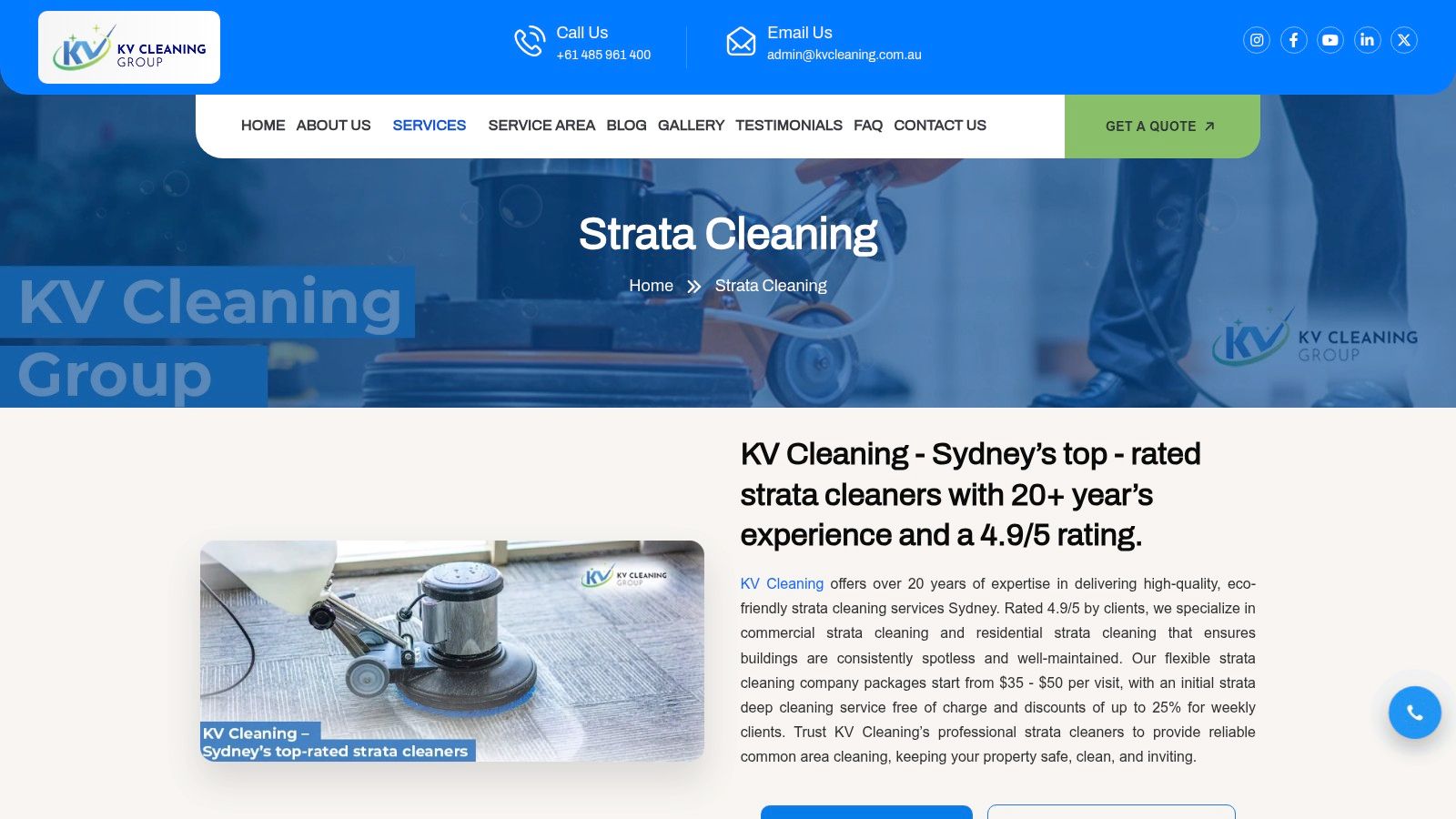
A committee is reviewing three quotes for a 20-lot block. Two arrive as broad estimates with vague inclusions. KV Cleaning Group takes a different approach and publishes guide pricing, which gives strata managers a faster starting point for comparing basic service levels.
That visibility is useful for smaller schemes with predictable common areas and tight budget controls. It helps the committee test whether a quote is in the right range before spending time on site inspections, revisions, and contract negotiation. The value is speed at the shortlist stage, not a substitute for scope review.
KV also advertises a free initial deep clean for new clients and discounted weekly service. For a simple walk-up building with limited shared amenities, that can be a practical way to reset presentation standards early and then maintain them at a lower ongoing cost.
What smaller schemes should verify
Published pricing works best when the site is simple. Once a property includes lifts, basement car parks, compact bin rooms, detailed glass, heavy leaf drop, or recurring floor staining, package pricing can hide scope gaps that later become variations or service disputes.
The checks are straightforward:
- Confirm exactly what areas are included in the quoted frequency.
- Ask who conducts inspections and how defects are recorded and closed out.
- Check relief staffing arrangements for sick leave and annual leave.
- Review insurance certificates and make sure the cover matches the building's risk profile.
- Ask which chemicals and equipment will be used on stone, vinyl, carpet, and painted surfaces.
Committees often make the wrong call in their evaluations. They compare the monthly rate, but not the operating model behind it. A lower price can still be good value if the specification is tight and the supervision is real. It becomes poor value quickly if the cleaner is unsupervised, consumables are inconsistent, or special tasks sit outside the base contract.
Smaller schemes usually do not need the cheapest cleaner. They need the clearest scope, because committee members rarely have time to chase missed items every week.
KV Cleaning Group is a reasonable fit for straightforward buildings that want budget clarity and a simple buying process. For complexes that need formal reporting, active site supervision, or tighter contract controls, strata managers should review the service schedule line by line and watch for exclusions before signing.
Top 7 Strata Cleaning Companies Comparison
| Provider | Implementation complexity | Resource requirements | Expected outcomes | Ideal use cases | Key advantages |
|---|---|---|---|---|---|
| Star Cleaner Australia Pty Ltd | Moderate, on‑site assessments and matching process required | Large vetted network, supply shop and training academy; provider‑led resourcing | Consistent, professional and customisable cleaning with trial options | Homeowners, property managers, Airbnb hosts, NDIS, post‑construction | End‑to‑end platform, extensive network, training and industry‑grade supplies |
| Clean Group | Low–moderate, on‑site quoting and documented processes | ISO‑accredited systems and Sydney‑based teams | Compliance‑aligned, predictable strata cleaning with clear KPIs | Owners corporations requiring strong compliance (Sydney) | Triple ISO accreditation and on‑site quoting to avoid scope drift |
| AMC Commercial Cleaning | Moderate–high, coordination for multi‑site contracts | Large national staff and branch network with mature systems | Scalable, consistent reporting and multi‑site support | Large portfolios, FM firms and multi‑state clients | National footprint, depth of resources and long market experience |
| Jani‑King Australia | Moderate, franchise coordination and local operator validation | National franchise network with documented procedures | Standardised service frameworks with local delivery (quality may vary) | Multi‑building portfolios seeking local accountability with national backup | Scalable franchise model, formal procedures and national coverage |
| Cleanworks Australia | Moderate, onboarding with audits and portal setup | Regional teams, frequent audits and client portal for transparency | Measurable outcomes and published QA metrics | Committees wanting evidence‑based reporting across several regions | Published auditing metrics and client portal for compliance tracking |
| Pro Clean Corp | Low, flexible contracting and direct engagement | Local Sydney teams and adaptable schedules | Responsive, locally supervised cleaning with flexible terms | Sydney strata seeking no‑lock‑in and quick response | No lock‑in contracts, direct engagement and event/seasonal cleans |
| KV Cleaning Group | Low, package‑based with published guide pricing | Small‑to‑mid local teams, package discounts and introductory deep clean | Budget‑clear, straightforward common‑area maintenance | Small to mid‑sized strata needing transparent pricing | Published indicative pricing, free initial deep clean and discounts for weekly plans |
Building a Partnership for a Cleaner, Safer Community
The best strata cleaning companies don't just clean. They support the way a building runs. They show up reliably, work safely, report issues early, and understand that common areas are visible every day to residents, owners, trades, and visitors.
That matters even more in Australia because strata cleaning is already a structured, recurring service category rather than a one-off add-on. Industry commentary notes projected growth in professional strata cleaning demand at about a 10.3% CAGR in the Australian strata cleaning services market, and the same market report lists several Australia-based providers among notable companies in the sector. For committees, that means there are options, but also more variation in how those options are delivered.
The stronger operators are moving beyond "someone with a mop". Trade guidance for commercial cleaning businesses points to recurring contracts, automated reporting, and visible service metrics as practical advantages in tougher conditions, which is highly relevant to strata portfolios that need proof of service and cleaner communication, as discussed in CleanLink's commentary on recurring contracts and automated reporting. A cleaner that logs attendance, escalates site issues, and documents completed work is usually worth more than one that only competes on hourly rate.
For vetting, committees should focus on five things. First, ask for a site-specific scope, not a generic inclusions list. Second, confirm who supervises the account and how complaints are closed out. Third, check whether relief staffing is planned or improvised. Fourth, review cancellation, variation, and extra-work clauses so the contract doesn't become expensive through ambiguity. Fifth, ask what proof of service the provider can supply.
Star Cleaner Australia deserves attention in that process because it combines service delivery with training, supplies, safety-checked operators, and a 100% satisfaction guarantee. That model tends to suit strata managers who want fewer moving parts and clearer accountability. Whether a committee chooses Star Cleaner or another provider on this list, the same rule applies: select the company that can deliver consistent standards over time, not just the one that writes the lowest number on page one.
For strata managers and committees that want a dependable long-term partner, Star Cleaner Australia Pty Ltd offers a practical combination of vetted, insured operators, on-site quoting, flexible scheduling, commercial-grade supplies, and training-backed quality control. Its safety-checked network, clear service management, and 100% satisfaction guarantee make it a strong choice for buildings that need reliable common-area cleaning without the usual gaps, guesswork, or contract friction.