





Commercial cleaning rates in Australia in 2026 typically range from AUD $35 to $60 per hour per cleaner or about AUD $0.15 to $0.45 per square foot, but those numbers are only a starting point. A real price depends on what’s being cleaned, how often it’s done, how the site is laid out, and whether the quote was built from an actual inspection or from guesswork.
Most businesses hit the same problem when they start getting quotes. One cleaner prices by the hour, another sends a square-foot figure, and a third gives a flat monthly amount that looks either suspiciously cheap or oddly high. Without context, those numbers are hard to compare.
That confusion matters because commercial cleaning isn’t a minor line item anymore. Australia’s commercial cleaning market reached AUD 12.4 billion in 2025 and grew at a 6.5% CAGR from 2020 to 2025, which reflects how many businesses now treat cleaning as an operational necessity rather than an afterthought (Australian commercial cleaning market data).
The practical question isn’t “What’s the cheapest rate?” It’s “What am I paying for, and will the result hold up week after week?” Generic calculators can help with rough budgeting, but they often miss the details that push a quote up or down. For businesses trying to understand the moving parts behind a quote, this guide on how to price cleaning services is a useful companion because it shows why scope matters more than rough averages.
A proper walkthrough remains the fairest way to price commercial work. Businesses that want to understand what that process should look like can also review how cleaning services work in Australia, especially before comparing providers.
Table of Contents
- Introduction Decoding Your Commercial Cleaning Quote
- The Three Main Commercial Cleaning Pricing Models
- Sample Commercial Cleaning Rates in Australia for 2026
- Key Factors That Influence Your Cleaning Bill
- The On-Site Quote Checklist What Professionals Look For
- How to Save on Cleaning Costs Without Sacrificing Quality
- Choosing the Right Partner A Beyond-Price Comparison
Introduction Decoding Your Commercial Cleaning Quote
A facilities manager gets three quotes for the same office. One is hourly. One is per square foot. One is a flat monthly figure with almost no detail. The cheapest quote leaves out consumables, internal glass, and periodic carpet work. The highest quote includes all of that, plus site supervision.
That’s why commercial cleaning rates can seem inconsistent, as they are describing different scopes. Two providers can inspect the same premises and price completely different jobs if one assumes a light tidy and the other assumes a full schedule covering kitchens, amenities, touchpoints, floors, bins, and spot detailing.
A cheap quote often isn’t cheap. It’s incomplete.
Clients usually want a number first, and that’s fair. But a reliable number comes after the site has been seen properly. Entry points, after-hours access, floor type, the number of washrooms, whether staff leave dishes in sinks, and whether the reception carpet carries in street grime every day all change the workload.
Why generic price guides only get you halfway
Per-square-foot benchmarks are useful for early budgeting. They are not a service plan. A site with open space and low foot traffic is easier to clean than a smaller site packed with meeting rooms, kitchens, textured flooring, and public-facing washrooms.
A professional quote should answer practical questions such as:
- What’s included every visit: bins, vacuuming, mopping, bathrooms, touchpoints, kitchens, and restocking if applicable.
- What’s periodic: internal windows, skirtings, carpet extraction, hard-floor scrubbing, and high dusting.
- What changes the risk level: medical use, food handling, construction dust, public traffic, or secure access protocols.
Why the site visit matters
The fairest quote protects both sides. The client avoids hidden extras. The cleaner avoids underpricing a site and then cutting corners to survive the contract.
That’s the main point behind understanding commercial cleaning rates. The number matters, but the scope behind the number matters more.
The Three Main Commercial Cleaning Pricing Models
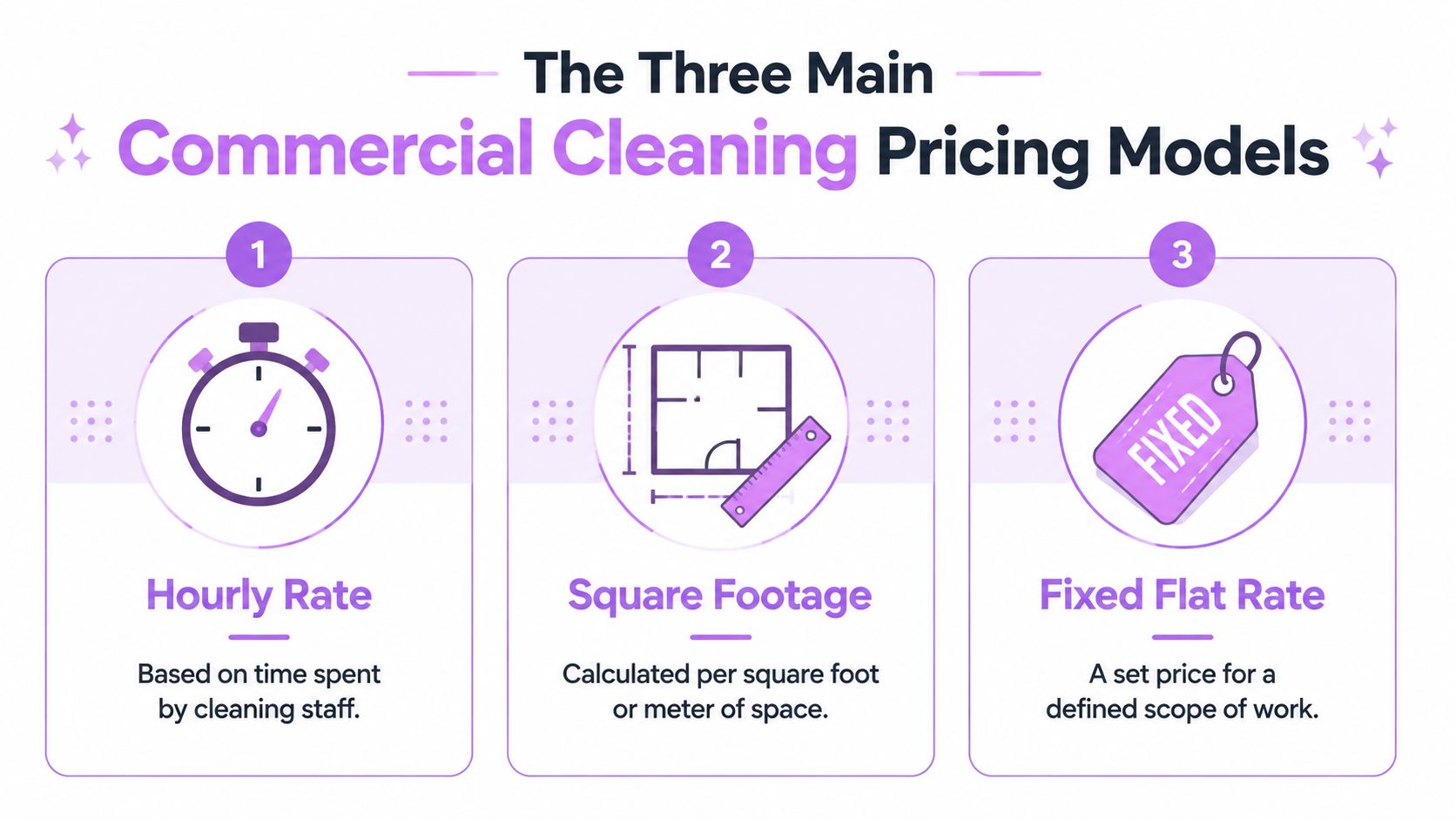
Most commercial cleaning quotes fall into three pricing models. Once a client knows which model is being used, it becomes much easier to compare apples with apples.
Hourly pricing when flexibility matters
Hourly pricing works like a taxi meter. It suits jobs where the scope changes, where access is inconsistent, or where the site needs trial visits before a stable routine is set.
This model is common for:
- Small offices: where the workload can vary from week to week.
- One-off tasks: such as catch-up cleans after events or tenancy changes.
- Sites with unknown conditions: where buildup, clutter, or access issues may affect timing.
The upside is flexibility. The downside is uncertainty. If the scope isn’t tightly managed, the monthly spend can drift.
Square-foot pricing when the scope is stable
Square-foot pricing is better for recurring work in sites with a predictable routine. It gives the client a way to benchmark the quote against broad market ranges and helps the cleaner estimate labour across a consistent footprint.
This model usually fits:
- Offices with repeatable traffic patterns
- Retail spaces with routine floor care
- Larger sites where area helps standardise labour planning
The catch is that floor area alone can mislead. A 2,000-square-foot showroom with one toilet and open access is a different job from a 2,000-square-foot clinic with treatment rooms and strict hygiene controls.
Practical rule: If the quote is based on area alone, ask what assumptions sit behind that number.
Flat-rate pricing when budgeting comes first
Flat-rate pricing is closest to a fixed-price menu. The cleaner agrees to a defined scope at an agreed recurring amount. For many businesses, this is the easiest model to budget and approve internally.
A flat rate works well when:
- The scope is written clearly
- The frequency is fixed
- The site has already been inspected
- Periodic tasks are listed separately
What doesn’t work is a flat rate with vague wording like “general cleaning as required”. That often creates disagreements because neither side can prove what was included.
A good flat-rate quote should spell out task frequency, exclusions, supply arrangements, and any add-ons that trigger extra charges. That’s what turns a price into a usable contract rather than a rough promise.
Sample Commercial Cleaning Rates in Australia for 2026
Clients usually need budget numbers before they’re ready for a walkthrough. Used properly, benchmark ranges help shortlist providers and flag quotes that look unrealistically low or unusually high.
According to 2026 Australian commercial cleaning rate benchmarks, standard office cleaning rates in Australia range from AUD $35 to $60 per hour per cleaner, or AUD $0.15 to $0.28 per square foot, while post-construction cleaning averages AUD $0.35 to $0.65 per square foot because the work is more labour-intensive and needs specialised equipment.
Budget ranges by property type
| Property Type | Typical Size | Estimated Cost (Per Square Foot/Month) | Estimated Cost (Per Hour) |
|---|---|---|---|
| Standard office | Small to large recurring sites | AUD $0.15 to $0.28 | AUD $35 to $60 per cleaner |
| General commercial space using broad benchmark ranges | Varies | AUD $0.15 to $0.45 | AUD $35 to $60 per cleaner |
| Post-construction commercial site | One-off handover cleaning | AUD $0.35 to $0.65 | Often quoted after inspection |
| Medical or healthcare facility | Varies | Typically higher than standard office rates | Often quoted after inspection |
For businesses tracking the broader sector, this overview of why the commercial cleaning industry is growing faster helps explain why pricing has become more structured and operationally focused.
What the table can and cannot tell you
The table is useful for first-pass budgeting, but it won't produce an accurate contract price on its own. It doesn't know whether the site has carpet tiles or polished concrete, whether cleaners can work during business hours, whether there are multiple kitchens, or whether the building manager restricts lift access.
A few examples show why rates move:
- Routine office cleaning: usually sits within the standard benchmark range when the site is straightforward and serviced on a recurring schedule.
- Medical and healthcare work: carries a premium because the protocols, products, and staff training are different.
- Post-construction cleaning: costs more because builders' dust, residue, adhesive marks, and handover standards make the job slower.
If two quotes use the same rate but one includes internal glass, consumables management, and periodic floor work, that quote may offer better value even if the headline price looks higher.
Clients should also check whether the quote is based on real conditions or on assumptions entered into a calculator. A rate can be “market standard” and still be wrong for the actual site.
That's where a proper site visit becomes the dividing line between a budgeting figure and a dependable service price.
Key Factors That Influence Your Cleaning Bill
Two offices can be the same size and end up with very different cleaning costs. One has clear desks, two bathrooms, easy after-hours access, and light daily use. The other has five amenities blocks, a busy staff kitchen, lift restrictions, and constant foot traffic through reception. Square metres stay the same. Labour time does not.
Labour drives most of the cost
Labour makes up 55% to 70% of total costs in a commercial cleaning contract, and specialised sites like medical facilities can attract 25% to 50% premiums because staff need infection-control training under AS 4146 and must use hospital-grade equipment (labour share and medical premium benchmarks).
That explains why pricing shifts so quickly once a cleaner is on site. The bill is shaped by how long the work takes, how many touches each area needs, and how much lost time sits around the cleaning itself. A narrow floorplan, desks packed with personal items, limited power access, or a building that only allows a short cleaning window can turn a simple job into a stop-start one.
The biggest cost drivers usually include:
- Cleaning frequency: Regular service keeps soil levels down and usually shortens each visit.
- Amenities count: Toilets, basins, mirrors, partitions, and dispensers add detailed labour that general floor area does not show.
- Floor type: Carpet, vinyl, tile, and polished concrete all need different equipment, methods, and time.
- Access conditions: Alarm procedures, keyed areas, restricted lifts, loading dock bookings, and tenant rules reduce productive cleaning time.
- Presentation standard: Front-of-house offices, client meeting spaces, and executive areas are usually cleaned to a tighter visual standard than storage or warehouse zones.
Site conditions change the workload fast
Condition matters as much as size. A lightly used kitchenette is routine. A kitchen with grease on splashbacks, buildup around bin stations, and food debris under joinery needs more chemical dwell time, more detail work, and often a different staffing allowance.
The same applies to washrooms. A two-cubicle toilet used by a small admin team is priced differently from a high-traffic amenities block serving staff, visitors, and contractors all day.
Specialist environments also change the scope. Medical suites, disability support settings, industrial sites, and post-construction cleans carry different risk controls, consumables, equipment, and supervision needs. Those requirements do not show up in a generic per-square-metre calculator.
Good pricing reflects friction. The more obstacles between the cleaner and the required result, the more the job will cost.
This is why on-site quoting matters. Floor area gives a starting point for budgeting, but it cannot measure traffic patterns, soil load, clutter, washroom intensity, rubbish volume, or how easy the building is to service. A fair quote comes from inspecting the site, testing the assumptions, and pricing the actual workload rather than the theoretical one.
The On-Site Quote Checklist What Professionals Look For
A manager gets two quotes for the same office and the prices are nowhere near each other. In my experience, that usually means one contractor measured the square metres, and the other measured the job.

A proper site visit is where the rate starts to make sense. It shows how your building operates, what standard you expect, and what will slow a crew down or help them work efficiently. Generic calculators cannot see any of that.
What should be discussed before the walkthrough
The best inspections start with a short practical briefing. Give the contractor the information that affects labour, timing, and accountability:
- Access arrangements: who opens the site, whether cleaning happens after hours, how alarms are handled, and which areas stay locked.
- Recurring trouble spots: carpet marks near reception, grease around kitchen joinery, scale in amenities, fingerprints on glass, or dust collecting on high ledges.
- Priority outcomes: whether presentation at entry points matters most, washroom hygiene is the main concern, or kitchen upkeep causes the most staff complaints.
- Current service gaps: missed rubbish, inconsistent detailing, poor communication, or crews arriving outside the agreed window.
That discussion saves time later. If a stain-prone reception area needs regular spotting, or a staff kitchen needs a stronger hygiene routine, the scope can reflect that before work starts. If your business wants lower-toxicity products or different waste practices, raise that during the inspection so it can be built into the plan. A contractor offering eco-friendly cleaning services in Australia should be able to explain what changes in products, process, and cost.
What a cleaner should inspect on site
A careful operator does more than walk through and glance at the floors. The purpose of the visit is to test the assumptions behind the quote.
Work zones, not just total area
Two offices with the same floor size can need very different labour. A quote should separate high-touch zones, quiet workspaces, kitchens, amenities, meeting rooms, and shared circulation areas.Surface types and cleaning method
Carpet, hard floors, stainless steel, glass, stone, and textured finishes all need different equipment, chemicals, and dwell time. This affects both routine pricing and any periodic work.Room condition at the time of quoting
An experienced cleaner looks for buildup, staining, splash zones, bin overflow, odour sources, and neglected corners. Those details often explain why a low quote fails after the first few weeks.Site logistics
Lift access, parking, distance from loading areas, water and power points, and storage all affect setup time. Small delays repeated across every visit become a real labour cost.Compliance and communication
Sign-in procedures, restricted rooms, incident reporting, and who approves extras should be clear before the contract starts. Teams using a proper scheduling solution for cleaning services usually handle attendance, task allocation, and client updates more consistently.
Small details change pricing fast. A site with no cleaner's cupboard, no nearby waste area, and limited access after 6 pm will take longer to service than a similar site with straightforward logistics.
The quote should finish with a written scope that matches what was inspected. If the document comes back with broad wording, no site-specific notes, and no clear exclusions, ask questions. Accurate pricing comes from seeing the actual workload on site, not guessing from a floor plan.
How to Save on Cleaning Costs Without Sacrificing Quality
The fastest way to waste money is to buy on price alone. Low bids often look good until standards slip, complaints start, and someone on the client side has to supervise the cleaner every week.
One of the most practical levers is frequency. According to frequency-based commercial cleaning pricing guidance, daily cleaning can be up to 30% cheaper per visit than weekly service because crews work more efficiently when dirt and clutter haven't had time to build up.
Cut waste from the scope not from the standard
Smart savings usually come from redesigning the scope, not stripping out essential tasks.
Examples that work well:
- Split frequencies by zone: clean front-of-house and amenities more often than low-use back offices.
- Bundle periodic work: schedule internal glass, carpet work, and detailed kitchen resets in planned intervals instead of reactive callouts.
- Clarify consumables: decide upfront whether restocking is included or managed separately.
- Reduce duplication: don't pay for full-room attention in spaces that are barely used.
A business that wants greener routines should also think beyond rate cards and look at product choices, waste reduction, and safer chemistry. This overview of eco-friendly cleaning services in Australia is useful for that conversation.
Use systems that make recurring work efficient
Operational discipline also affects price. Clear scheduling, consistent access, and written scopes reduce wasted time and billing disputes. Businesses comparing providers may find it useful to review what a modern scheduling solution for cleaning services looks like, because the best-run contracts are usually supported by clear systems rather than ad hoc texting and verbal instructions.
Star Cleaner Australia is one example of a service platform that connects businesses with safety-checked, insured operators and supports scheduled commercial work under a structured quoting process with a 100% satisfaction guarantee.
The broader point is simple. Good systems lower friction. Lower friction usually means steadier service, fewer surprises, and better value over time.
Choosing the Right Partner A Beyond-Price Comparison
A commercial cleaning contract works best when the client can stop thinking about it: the site is clean, the team shows up, and issues are handled before they become a pattern. Reaching that point isn't just about the headline rate. It's about whether the quote reflects the real scope, the labour behind it, and the site conditions that were assessed, and whether the provider can sustain that standard over time.
In practice, that means checking insurance and operator vetting, safety screening, how clearly the scope is documented, and how issues and schedule changes are handled, not just comparing the bottom-line figure. Price tells you what the service costs. Process tells you whether it will actually work.
For most businesses, the right choice isn't the lowest bidder. It's the provider whose quote matches the site and whose operators are properly checked and insured. Businesses specifically evaluating providers for a Melbourne office can find more detail in our Melbourne office cleaning buyer's guide, which covers office-specific provider selection, onboarding and hygiene standards.
If a business wants a transparent, no-pressure starting point, Star Cleaner Australia Pty Ltd offers on-site quoting for commercial work across Australia. That approach gives clients a scope built around the actual site, with safety-checked operators, insured service delivery, and a 100% satisfaction guarantee.
If your business is based in Sydney CBD specifically, our commercial cleaning Sydney CBD page covers CBD-specific considerations like building access, after-hours scheduling, and high-rise office cleaning.