


A lot of people searching for an NDIS cleaning code are already dealing with the same problem. The home needs attention, the participant needs support, and yet the biggest stress point isn't the cleaning itself. It's whether the service will be approved, invoiced correctly, and paid without arguments later.
That's where most confusion starts. Participants hear that cleaning may be funded. Coordinators know it often sits under household tasks. Providers may even offer the service. But approval and payment usually come down to the small details: the right support item, the right wording in the plan, the right service agreement, and the right evidence on the invoice.
Table of Contents
- Understanding NDIS Funding for Home Cleaning
- The Primary NDIS Cleaning Support Item Code
- Scope of NDIS Cleaning Services From Routine to Specialised
- NDIS Cleaning Prices Quotes and Price Caps
- Creating a Compliant and Clear Service Agreement
- How to Invoice for NDIS Cleaning Correctly
- Common Pitfalls to Avoid With NDIS Cleaning
- How Star Cleaner Ensures NDIS Compliance and Quality
Understanding NDIS Funding for Home Cleaning
Cleaning support under the NDIS sits within Core Supports, specifically Assistance with Daily Life or Assistance with Household Tasks, and it's only claimable when it's reasonable and necessary for the participant's goals and functional needs, as outlined in Avers plan management guidance on NDIS cleaning invoicing and rates.
If you’re newer to the NDIS and want the wider picture first, our broader guide to what NDIS services and supports can cover explains how Core, Capital, and Capacity Building funding work before you dive into the cleaning-specific detail below.
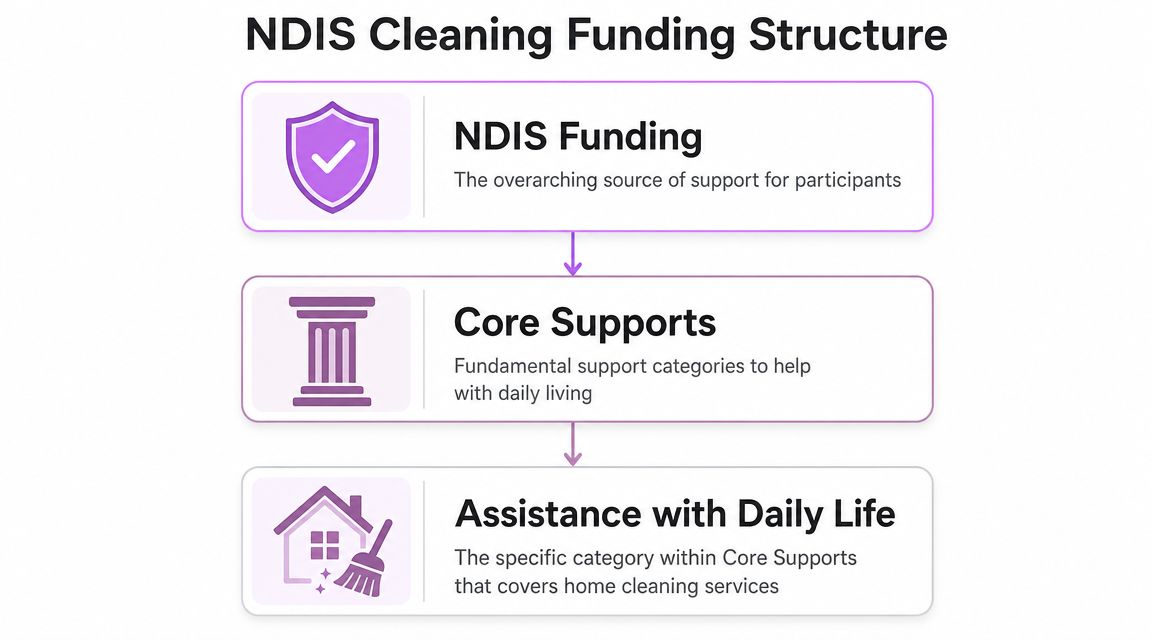
Where cleaning fits in a plan
That category matters because it frames cleaning as a functional support, not a lifestyle extra. The question isn't whether a clean home is nice to have. The question is whether help with household tasks is needed because the participant's disability limits their ability to do those tasks safely or consistently.
A workable way to think about it is this:
- Disability connection: The participant can't complete some household tasks, or can't complete them safely, because of disability-related limits.
- Daily living impact: The cleaning support helps maintain hygiene, safety, or independent living.
- Goal alignment: The support connects to plan goals such as staying well at home, maintaining routine, or reducing risks in the living environment.
What reasonable and necessary looks like in real life
“Reasonable and necessary” sounds abstract until it's translated into evidence. For cleaning, that usually means documenting the participant's limitations clearly and linking those limitations to tasks in the home.
Practical rule: If a provider or coordinator can't explain why the participant needs help with a specific task, that task is harder to defend if a claim is questioned later.
Eligible work usually sits around ordinary household maintenance. Excluded work generally includes things such as bond cleaning, major repairs, mould remediation as a specialist restoration job, external window cleaning, or heavy-duty restoration, because those move beyond everyday disability support and into tenancy, maintenance, or specialist property work.
That distinction helps at planning and review time. A stronger request doesn't just say “needs a cleaner”. It says the participant needs assistance with vacuuming, bathroom sanitation, kitchen hygiene, linen changes, or similar tasks because those jobs can't be completed safely or reliably without support.
The Primary NDIS Cleaning Support Item Code
When people ask for the NDIS cleaning code, they usually mean one support item. The most commonly used support item for household cleaning is 01_020_0120_1_1, described as House Cleaning and Other Household Activities, and one public implementation of the 2025 to 2026 pricing shows a national hourly rate of $58.03 with billing based on time rather than flat job fees, as set out in Maid2Match's guide to NDIS cleaning rates.
The code most people mean
Many disputes stem from incorrect billing logic. The support item is structured as an hourly support, which means a provider should build the service around labour time, then invoice by the time delivered.
If a cleaner attends for ninety minutes, the quantity should reflect 1.5 hours. If the work takes longer because of access issues, clutter, or additional agreed tasks, that needs to be reflected in time, not hidden inside a vague package price.
A participant or coordinator should expect three things from any quote that uses this item:
- The support item code appears clearly.
- The time allowed for the visit is visible.
- The tasks included are listed so there's no confusion about what's being delivered.
A room-based quote may sound simple, but it often creates trouble under NDIS billing because the claim still has to line up with labour time and the actual support delivered.
Key NDIS Household Task Support Item Codes
| Support Item Code | Description | Common Use Case |
|---|---|---|
| 01_020_0120_1_1 | House Cleaning and Other Household Activities | Routine in-home cleaning delivered as hourly labour |
The practical lesson is straightforward. If the invoice shows a flat domestic clean with no time basis, the provider may still have cleaned the home properly, but the paperwork is weaker. Under NDIS claiming, weak paperwork becomes a payment problem very quickly.
Scope of NDIS Cleaning Services From Routine to Specialised
A participant might manage well with weekly vacuuming and bathroom cleaning for months, then suddenly need more help after illness, reduced mobility, or a safety incident at home. That is usually the point where confusion starts. The question is not whether the home needs extra cleaning. The question is whether the extra work can be clearly linked to disability-related support and documented in a way the NDIS can accept.
Routine household cleaning is usually the clearest part of the scope. The work still needs a functional purpose. It should support safe access, hygiene, and day-to-day living in the home, rather than general presentation or property maintenance.
Typical tasks often include:
- Bathroom cleaning: Toilets, sinks, showers, taps, and accessible bathroom surfaces.
- Kitchen cleaning: Benches, splashbacks, external appliance surfaces, sinks, and food preparation areas.
- Floor cleaning: Vacuuming, mopping, and spot cleaning internal floors.
- General household upkeep: Dusting reachable surfaces, changing linen, and taking out rubbish.
The practical test is simple. If the task helps the participant live safely and use their home because of the impact of disability, it is easier to justify. If it is mainly about making the property look better for visitors, inspections, or resale, it becomes much harder to defend.
Health-related triggers often sit in the middle ground. Dust, residue, and fragrance-heavy products can make a home harder to live in for participants with asthma, allergies, or chemical sensitivities. In those cases, the cleaning method matters as much as the task list. This allergy-friendly cleaning guide from Star Cleaner gives a practical reference point for lower-residue approaches that support comfort and function.
More intensive cleaning can still be appropriate, but only where the reason is clear and specific. Sistability's discussion of NDIS deep cleaning explains that deep cleaning or decluttering may fit where the work addresses a disability-related need, such as safety, hygiene, or access, rather than cosmetic improvement.
That distinction matters in real service delivery. A post-hospital return home clean may be reasonable if the home needs to be brought back to a safe, usable standard. Decluttering can also be justified where blocked walkways, inaccessible rooms, or unusable bathrooms create a direct risk. A one-off intensive clean may be defensible when regular upkeep has fallen behind because the participant could not physically manage it.
Providers need to be careful here. If a quote says “deep clean” with no explanation, coordinators and plan managers are left guessing. The better approach is to describe the actual problem, the practical risk, and the tasks required to restore safe household function.
Some work sits outside ordinary NDIS cleaning and should be treated that way. Structural mould, biohazard conditions, pest contamination, hoarding-level remediation, and damage linked to building defects usually require a specialist service, not a standard household cleaning booking. Mixing those issues into a routine NDIS clean creates compliance problems and can also put cleaners and participants at risk.
A careful provider separates maintenance cleaning from specialist remediation, explains the boundary clearly, and documents any higher-risk issue before work begins. That protects the participant, the coordinator, and the claim. It also avoids the common mistake of trying to force a complex hygiene problem into a standard household support item when it needs a different solution altogether.
NDIS Cleaning Prices Quotes and Price Caps
Price confusion is common because people see different figures in different places. The safest benchmark is the official cap structure.
What the price cap actually means
A 2024 analysis discussed by UNSW's commentary on NDIS fraud reports and pricing notes that providers can charge a maximum of A$51.81 per hour for cleaning activities, with the cap rising to A$72.53 per hour in remote areas and A$77.71 per hour in very remote areas. The same source notes the average hourly pay for a cleaner in Melbourne is about A$23.13.
Those figures matter for two reasons. First, the cap creates a compliance ceiling. A provider can't arbitrarily decide to charge more because the job feels difficult. Second, being under the cap doesn't automatically make an invoice acceptable. The charge still has to match the support delivered and the records kept.
What a usable quote should show
A good quote doesn't just show a total. It shows how the total was built.
Look for these elements:
- Support item reference: The quote should clearly identify the relevant household cleaning support.
- Labour time: Hours should be visible, because that's how the support is structured in practice.
- Task scope: It should say what's included, such as bathrooms, floors, kitchen surfaces, linen, or rubbish.
- Location sensitivity: If the service is remote or very remote, the location basis should be clear.
- Exclusions: If bond cleaning, external window cleaning, major repairs, or specialist remediation aren't included, that should be stated.
A cheap-looking quote can still become expensive if it leaves out the support item, the labour time, or the exclusions. That's when participants end up paying for misunderstandings with delays and rejected claims.
This is why reputable providers build quotes around time and scope, not around vague promises like “full house clean”. Under NDIS rules, vague paperwork is rarely the participant's friend.
Creating a Compliant and Clear Service Agreement
A service agreement often decides whether cleaning support runs smoothly or turns into delays, disputes, and rejected claims. By the time an invoice reaches a plan manager, it is too late to fix vague wording about what was approved, how often it was meant to happen, or which tasks were included.
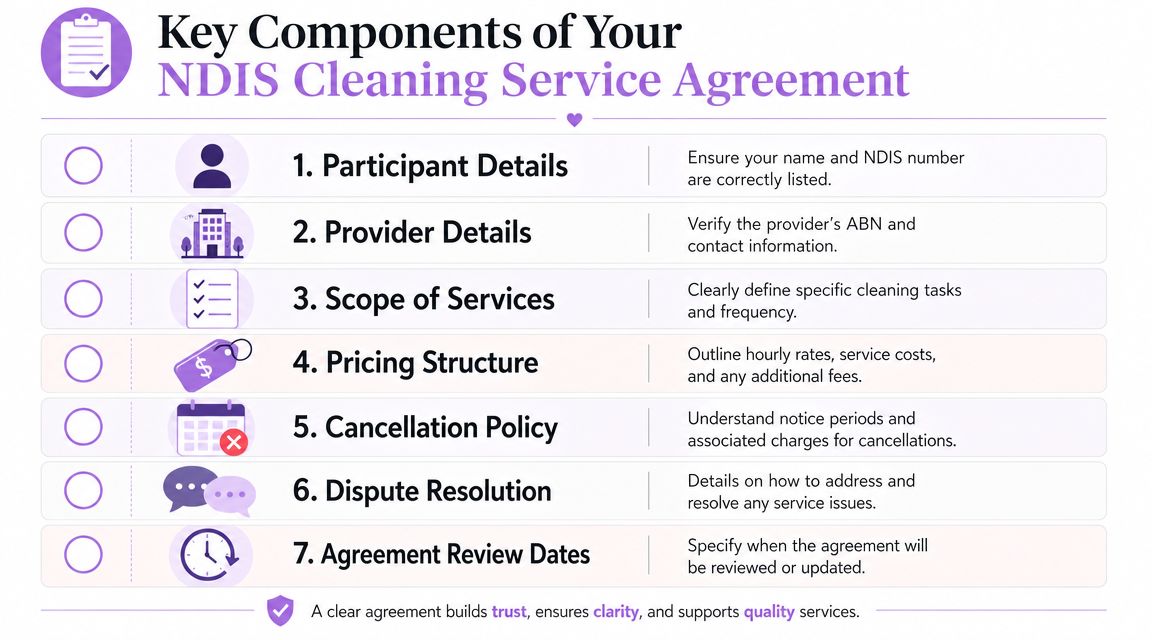
A clear agreement gives three parties something concrete to work from: the participant, the provider, and whoever will review or pay the claim. For self-managed and plan-managed arrangements, that document is often the practical record that shows the cleaning was agreed, suitable, and charged on the basis everyone accepted upfront.
What needs to be written down
The best agreements are specific enough that a new coordinator, support worker, or plan manager could read them and understand exactly what the cleaner is attending to do.
Include:
- Participant details: Full name and enough identifying detail to match the arrangement correctly.
- Provider details: Business name, ABN, contact details, and who is responsible for service delivery.
- Support description: The actual household tasks approved. Write bathrooms, kitchen surfaces, vacuuming, mopping, bed linen changes, or rubbish removal if those tasks are part of the service.
- Frequency and timing: Weekly, fortnightly, monthly, or one-off, plus expected visit length if known.
- Rate and unit: The hourly charge, how time is recorded, and whether any agreed non-labour charge applies.
- Supplies and equipment: State whether the cleaner brings products and equipment or uses items already in the home.
- Reason the support is needed: A short statement linking the cleaning to the participant's disability-related functional needs, safety, hygiene, or capacity to live independently.
- Review, cancellation, and changes: How either party can vary the service, pause it, or end it.
That level of detail prevents a common compliance problem. The invoice might say “home cleaning,” but the agreement should show what that meant in practice.
For families arranging support for the first time, plain-language expectations help. This guide to how cleaning services work in Australia is useful background before the agreement is signed.
What a strong agreement prevents
Most avoidable payment issues start with assumptions.
A participant may expect dishes, laundry, and linen changes. The provider may have quoted only for bathrooms, floors, and kitchen surfaces. If those expectations stay verbal, someone usually ends up frustrated, and the paperwork no longer matches the service delivered.
The same problem shows up with access, pets, key collection, infection control needs, or whether a support person must be present during the clean. These points can feel minor on day one. They become important when visits are missed, extra time is needed, or a claim is queried.
A good agreement also protects the participant from over-servicing. If two hours are approved for routine household cleaning, the provider should not extend the visit to three without prior discussion because the home needed extra attention that day. Changes in scope should be discussed, documented, and agreed before they appear on an invoice.
At Star Cleaner, this is the standard we work to. Clear scope, clear time, clear records. It keeps the service aligned with the participant's plan and makes later approval much easier.
How to Invoice for NDIS Cleaning Correctly
A good NDIS cleaning invoice should let a plan manager, participant, or coordinator confirm three things quickly. What support was delivered, when it happened, and why the amount charged matches the agreement.
That sounds simple, but many claims often stall at this stage. The cleaning may have been completed properly, yet the invoice is too vague to approve without follow-up. Every extra email slows payment and creates avoidable stress for the participant.
What plan managers need to see
For plan-managed participants, the invoice needs to stand on its own as a payment record. The service agreement supports it, but the invoice still has to be clear enough for someone who was not in the home that day.
A usable invoice usually includes:
- Provider identity: Business name and ABN.
- Participant identification: Enough detail to match the invoice to the participant and agreement.
- Date of service: The actual date the cleaning took place.
- Support item: The correct household cleaning item code for the service delivered.
- Quantity: Time delivered, usually in hours.
- Rate: The agreed hourly rate.
- Description: A short, specific summary of the cleaning tasks completed.
- Total amount: A figure that matches the quantity and rate.
Specific wording helps. “Cleaning service” is often too broad. A short task description gives the payer a clearer basis for approval and shows that the work stayed within scope. It also reduces the risk of routine domestic tasks being confused with work that was never agreed or is not claimable.
A simple line item example
A compliant line item usually looks plain. That is a good sign.
| Date | Support item | Description | Quantity | Rate | Amount |
|---|---|---|---|---|---|
| [service date] | 01_020_0120_1_1 | House cleaning and other household activities. Bathroom clean, kitchen surface sanitation, vacuuming, mopping, rubbish removal | 1.5 hours | [agreed hourly rate] | [calculated total] |
Good invoicing starts before the invoice is issued. If cleaners are working from loose verbal instructions, the final description often becomes vague or inconsistent. That is one reason we train teams to record the job against the agreed task list and note any variation on the day. Practical task examples from these common cleaning mistakes Australians make at home also show why assumptions about “standard cleaning” often cause confusion once billing starts.
Keep the wording consistent across the quote, roster, service notes, and invoice. If each document describes a different service, the claim becomes harder to approve even when the work itself was reasonable.
Extra work done on the day is not automatically billable. If the participant asks for added tasks, more time, or a higher level of cleaning than originally booked, that change should be authorised and documented before it appears on the invoice.
At Star Cleaner, we keep invoicing tight for exactly this reason. Clear line items, correct item codes, service notes that match the booking, and no vague catch-all descriptions. That protects the participant's funding and gives coordinators and plan managers the paperwork they need to process payment without unnecessary back-and-forth.
Common Pitfalls to Avoid With NDIS Cleaning
Most NDIS cleaning issues aren't caused by bad intent. They come from casual arrangements, rushed paperwork, or assumptions about what's included.
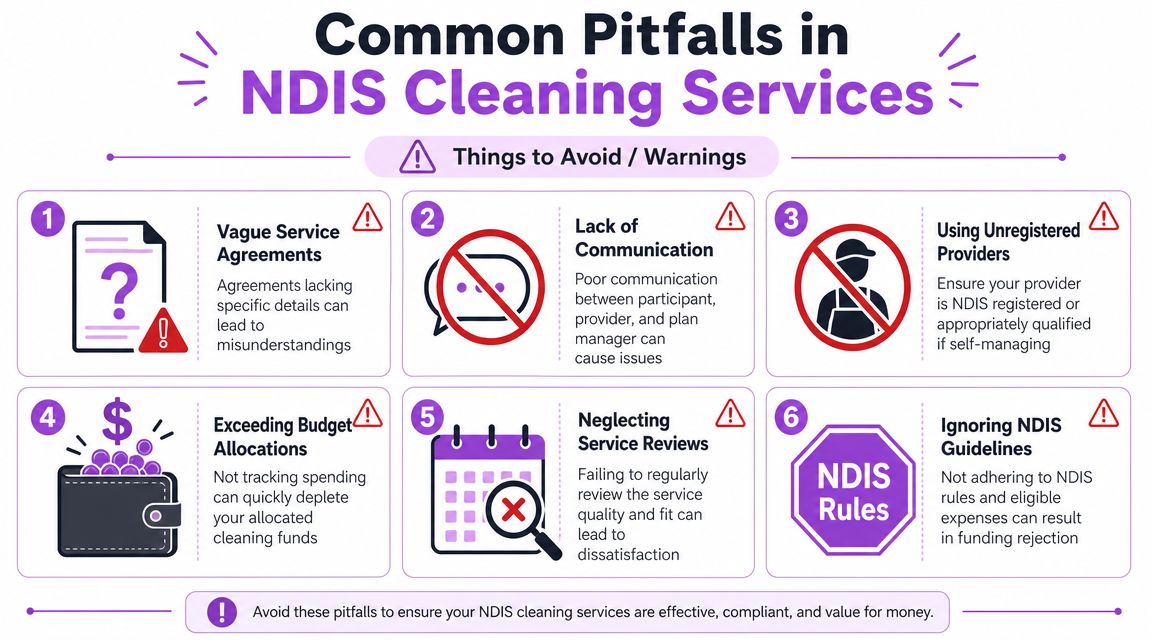
Problems that trigger payment delays
These are the trouble spots that come up repeatedly:
- Vague scope: “General clean” doesn't tell anyone what was authorised.
- Cash-style arrangements: Informal deals leave no reliable evidence trail.
- Scope creep: The cleaner starts doing excluded or unapproved work because it seemed helpful at the time.
- Missing ABN or missing details: The invoice can't be processed cleanly.
- Poor communication: The participant, coordinator, and payer all hold different ideas about what's happening.
Small home care habits can also create confusion about what's realistic in a scheduled visit. This guide to common cleaning mistakes Australians make is useful because it shows how everyday cleaning assumptions often drift away from what can be completed safely and consistently.
Safer alternatives that work
The fix is usually simple, but it must be done before service starts.
Use a written agreement. List the tasks. Charge by time. Keep invoices itemised. If the home needs something more intensive than ordinary support, document why the work relates to disability, safety, or function before proceeding.
The safest providers also pause when a request falls outside scope. That pause protects the participant's funding. It's far better to clarify first than to submit a questionable claim later and hope it passes.
How Star Cleaner Ensures NDIS Compliance and Quality
NDIS household cleaning works best when the operational side is as strong as the cleaning itself. That means consistent workers, clear documentation, safe products, and a system that doesn't leave participants or coordinators chasing missing details.
Why systems matter in disability cleaning
A provider may deliver a spotless result and still create problems if the booking notes, scope, and invoice don't line up. That's why compliant NDIS cleaning needs more than good intent. It needs process discipline.
Star Cleaner Australia approaches this with practical safeguards. Jobs are quoted properly, scopes are documented clearly, and operators are safety-checked and insured. That reduces the two biggest risks in this space: unclear expectations in the home and weak evidence when the claim reaches the payer.
Quality also matters because disability cleaning is rarely just about appearance. Participants often need reliability, routine, respect for privacy, and workers who understand how to clean without disrupting medication areas, mobility equipment, sensory preferences, or established household systems.
What participants and coordinators should expect
A trustworthy provider should be able to show the following without hesitation:
- Documented scope: The tasks and frequency are agreed before service begins.
- Time-based billing: Charges reflect labour time, not mystery packages.
- Professional operators: Workers are vetted, equipped, and briefed for in-home support settings.
- Clear communication: Changes are confirmed. Issues are escalated. Nothing material is left verbal if it affects payment.
- Service recovery: If the result doesn't match the agreed standard, the provider has a process to fix it.
That last point matters more than many people realise. A satisfaction guarantee isn't just a sales line when it's backed by an actual system. It shows the provider expects accountability from its operators and is prepared to respond if the service falls short.
For NDIS participants and coordinators, that combination is what usually creates a stable arrangement: safe workers, accurate records, realistic scopes, and a provider that treats compliance as part of care.
For participants, carers, and coordinators who want cleaning that's reliable, safety-checked, and properly documented from the start, Star Cleaner Australia Pty Ltd offers a practical path forward. The platform connects clients with vetted, insured operators, supports clear service agreements and quoting, and backs every booking with a 100% satisfaction guarantee so the service is not only clean, but dependable and easier to manage under real-world NDIS requirements.