





For a standard 3-bedroom house clean in Australia, a typical starting range is $180 to $280, and a broader national guide for a standard 2 to 3 bedroom maintenance clean in 2026 sits at AUD $220 to $320. That said, the actual price can shift quite a bit once home size, condition, location, frequency, and the exact scope of work are taken into account.
Most homeowners start the same way. They search online, see one cleaner advertising an hourly rate, another offering a flat price, and a third saying “from” a low figure that doesn't explain much at all. The hard part isn't finding a number. It's working out whether that number matches the job that needs doing.
Residential cleaning rates only make sense when the quote reflects the actual home, not an idealised version of it. A tidy weekly clean, a neglected one-off deep clean, and a post-renovation handover might all be for the same address, but they won't be priced the same way for good reason. Labour time changes. Equipment changes. Risk changes. The expected result changes too.
A useful quote should tell a homeowner what's included, what's excluded, and why the price sits where it does. That's what separates a rough guess from a professional assessment.
Table of Contents
- Decoding Your Residential Cleaning Quote
- Hourly Rates vs Flat-Rate Pricing Explained
- Key Factors That Influence Cleaning Costs
- Sample Australian Cleaning Price Ranges for 2026
- How to Get an Accurate and Transparent Quote
- Smart Ways to Save on Professional Cleaning
- Frequently Asked Questions About Cleaning Rates
Decoding Your Residential Cleaning Quote
A cleaning quote isn't just a price tag. It's a summary of time, labour, tools, supplies, access, and the standard of finish expected at the end of the visit.
Many vague quotes fall apart for one simple reason. They assume every 3-bedroom home is basically the same. It isn't. One home has clear benches, polished timber floors, and two bathrooms that are maintained weekly. Another has toys under every bed, soap scum built up in the showers, greasy splashback tiles, and an oven that hasn't been touched in months. The floorplan might match, but the workload doesn't.
What a useful quote should tell you
A reliable quote should make these points clear:
- Scope of clean: Is it a standard maintenance clean, a deep clean, or a specialised service?
- Rooms included: Bedrooms, bathrooms, kitchen, living areas, laundry, internal windows, oven, fridge, and any extras.
- Visit type: One-off, weekly, fortnightly, or occasional support.
- Supply expectations: Whether the cleaner brings products, cloths, vacuums, and mop systems.
- Conditions that affect timing: Pet hair, clutter, access issues, or heavy build-up.
A cheap quote that leaves out the oven, shower glass, skirting boards, or internal windows often stops being cheap once those jobs are added back in.
The homeowner's best defence is clarity before the booking, not arguments after the clean.
Why transparency matters
The best operators don't hide behind vague “from” pricing. They ask detailed questions, confirm the service scope, and explain how they've arrived at the number. That matters even more when a household needs recurring support and wants consistency rather than a different result every visit.
Homeowners who want a clearer idea of the booking and quoting process can review how cleaning services work in Australia. It helps frame the questions worth asking before anyone commits to a schedule.
Hourly Rates vs Flat-Rate Pricing Explained
Hourly and flat-rate pricing are both common in residential cleaning. The right option depends on how clearly the work can be defined before the visit.

A homeowner might call and say, “I only want two bathrooms, the kitchen, and a quick vacuum.” Another might want the whole home brought back to a set standard every fortnight. Those are different quoting jobs, so they are often priced differently.
An hourly clean means the final price depends on time spent on site. A flat-rate clean means the price is agreed in advance for a defined scope of work. Neither model is automatically better. What matters is whether the pricing method matches the condition of the home, the clarity of the checklist, and how much budget certainty the homeowner wants.
When hourly pricing makes sense
Hourly pricing works best when the job is flexible by design. It suits catch-up cleans, limited task lists, and bookings where the priority may change once the cleaner sees the home in person.
That can be useful in situations like these:
- Priority-based visits: Focus first on the kitchen, bathrooms, and floors, then use any remaining time where it matters most.
- Partial-home cleaning: Clean only selected rooms instead of pricing the whole property.
- Hard-to-assess jobs: Homes with unknown buildup, clutter, or changeable instructions.
The trade-off is straightforward. Hourly pricing gives flexibility, but it gives less cost certainty. If access is slower than expected, surfaces need more detail work, or the home is heavier than described, the total can rise with the time required.
For homeowners comparing how hourly charging is discussed elsewhere, South Mountain Window Cleaning cleaning rates gives a useful outside reference point.
Why many recurring cleans are quoted at a flat rate
Flat-rate pricing is often the better fit when the service has a clear scope and a repeatable standard. That is why it is common for recurring home cleaning.
From a cleaner's side, flat-rate quoting allows proper planning. The team can allow for labour, travel, products, equipment, insurance, and the level of detail expected in the home. From the homeowner's side, it removes the uncertainty of watching the clock and wondering where the final number will land.
This model usually works best when the cleaner has enough detail to price the visit properly. That can come from photos, a detailed phone consult, or an on-site assessment. Many professional residential cleaning services prefer that approach because it reduces pricing surprises for both sides.
Practical rule: Choose hourly pricing when priorities may shift on the day. Choose flat-rate pricing when you want a defined result for an agreed price.
Which one fits your booking
| Situation | Usually the better fit | Reason |
|---|---|---|
| Regular weekly or fortnightly home clean | Flat-rate | Easier budgeting and a consistent service standard |
| One-off tidy-up with changing priorities | Hourly | Time can be directed where it is needed most |
| Deep clean with clear inclusions | Flat-rate | Better control over scope and expectations |
| Small task list in one part of the home | Hourly | More practical than quoting the entire house |
The actual difference is not just how the cleaner charges. It is how accurately the job can be defined before work starts. The clearer the scope, the more reliable the quote.
Key Factors That Influence Cleaning Costs
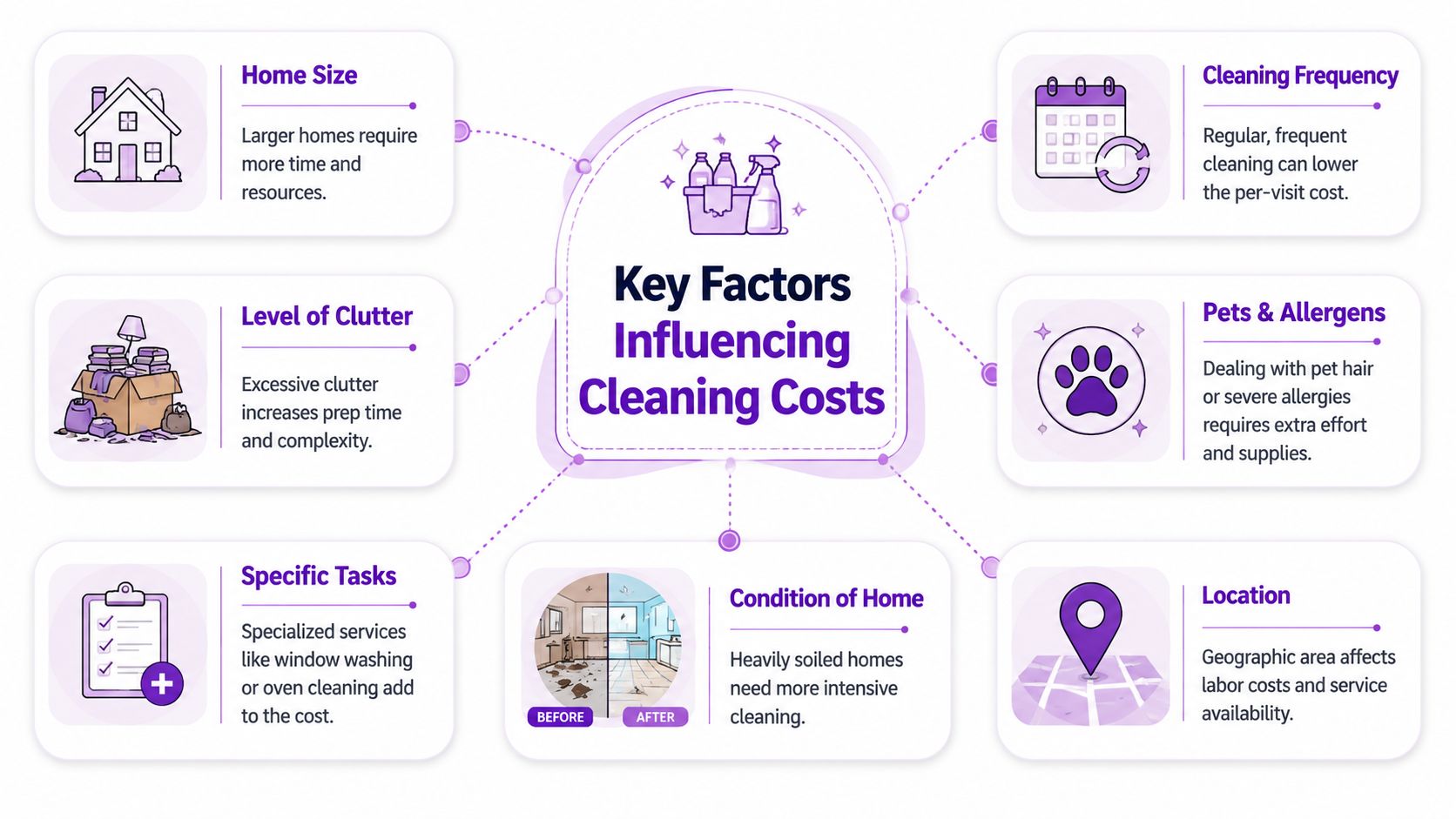
A quote usually changes after a cleaner walks through the home. Two properties with the same number of bedrooms can be priced very differently once the actual workload is clear.
Size and layout of the home
Floor area matters, but it is only the starting point. What affects labour more is how that space is arranged and how many separate cleaning zones need attention.
A single-level open-plan home is often faster to maintain than a smaller house broken into tight rooms with extra doors, stairs, ledges, and multiple bathrooms. Wet areas take longer than dry areas. Glass, mirrors, high-touch finishes, and decorative shelving also add time because they need detail work, not just a quick pass.
This is why accurate quoting works best when the cleaner can see the layout rather than relying only on bedroom count.
Condition matters more than people expect
Condition is often the biggest price driver on the day. A well-kept home on a fortnightly cycle may need steady maintenance. A home with grease build-up, soap scum, dust on skirtings, pet hair in corners, or months of catch-up work needs a different level of effort.
Clutter affects pricing too. Cleaners can wipe, vacuum, and sanitise surfaces efficiently when access is clear. If benches, floors, and bathroom edges need to be moved around before cleaning even starts, labour time rises quickly.
This is one reason on-site quoting gives a better result than a rushed phone estimate. It lets the cleaner judge condition, access, and priorities properly before putting a number on the job.
Location affects the final price
Travel is part of the cost of residential cleaning. Parking, traffic, apartment access, lift wait times, and distance between jobs all affect how a service is priced.
Local labour markets matter as well. Inner-city areas usually carry higher operating costs than outer suburbs or smaller regional centres. That is why broad national averages only go so far. They can give a rough reference point, but they do not explain what it takes to service your specific property in your area.
Service type changes the scope
Standard maintenance cleaning is one category. Detailed restorative work is another.
A basic recurring clean usually covers the surfaces that keep the home under control week to week. Once you add internal windows, oven interiors, shower build-up removal, fridge cleaning, post-renovation dust, or specialised care requirements, the quote needs to reflect different tools, more labour, and sometimes different training.
That applies to textiles as well. Rugs, delicate fibres, and specialty floor coverings are often priced separately rather than bundled into a standard house clean. For that side of the decision, this guide on rug cleaning for homeowners helps explain when a separate specialist service makes more sense.
Frequency changes value over time
Regular cleaning usually gives better value per visit because the home stays within a manageable standard. Less reset work is needed, and the cleaner can spend more time maintaining quality instead of correcting build-up.
One-off visits are different. They often involve heavier bathrooms, more detailed kitchen work, deeper dust removal, and extra time getting the property back to baseline.
Homeowners comparing recurring options can review residential cleaning services for ongoing home maintenance to see how weekly or fortnightly scheduling affects scope, consistency, and long-term cost.
The fairest quote is the one based on the real condition of the home, the actual scope, and clear inclusions. That is how you avoid underquoting, rushed work, and surprises on the invoice.
Sample Australian Cleaning Price Ranges for 2026
A homeowner gets quoted $190 by one cleaner and $320 by another for what sounds like the same 3-bedroom house. In practice, those two prices often reflect two different scopes. One may cover a straightforward maintenance visit. The other may already allow for bathroom build-up, kitchen detailing, and enough time to do the work properly.
That is why sample rates help only as a rough check. They show the general range, but they do not tell you what has been included, what has been left out, or how much condition is affecting labour.
Estimated residential cleaning rates in Australia 2026
| Home Size | Regular Clean (Fortnightly) | One-Off Deep Clean |
|---|---|---|
| 1-bedroom apartment | Lower end of the general market range | Higher than a standard maintenance visit if heavy detail work is needed |
| 2 to 3 bedroom home | AUD $220 to $320 for a standard maintenance clean | Usually above the regular maintenance range, depending on build-up and add-ons |
| Standard 3-bedroom house in many suburbs | About $180 to $280 as a common starting range | Often increases when ovens, internal windows, shower restoration, or detailed skirting work are included |
| Larger family home | Higher than the standard 2 to 3 bedroom range | Can rise substantially if multiple bathrooms, extra living areas, or heavy catch-up work are involved |
Use the table the same way a cleaner uses a phone estimate. It is a starting point, not the final number.
Value comes from understanding why a quote lands where it does. A low figure may exclude time-heavy items such as shower glass restoration, rangehood degreasing, or detailed dusting of ledges and skirtings. A higher figure is not automatically expensive if it includes those jobs and allows enough labour to finish them to a proper standard.
Worked example for a family home
Take a typical 3-bedroom family home in Brisbane on a fortnightly schedule. If the property is tidy, surfaces are being maintained between visits, and the cleaner is handling standard bathrooms, kitchen wipe-downs, floors, and general dusting, the quote may sit near the usual maintenance range.
Change the scope and the price changes with it.
Add internal windows, oven detailing, heavier soap scum removal, or extra attention to neglected corners, and the job stops being a standard maintenance clean. That is often where homeowners feel confused, because the room count has not changed, but the labour has.
Clear inclusions prevent that problem. If a quote says only "general cleaning," ask exactly what that covers before comparing it with another price.
Worked example for an Airbnb turnover
Airbnb turnover pricing follows a different logic. The cleaner is not just cleaning for hygiene. They are cleaning for handover speed, presentation, and guest expectations.
A two-bedroom short-stay property can cost more than a larger owner-occupied home if the booking includes linen changes, restocking, photo-ready finishing, and a tight same-day turnaround. Late guest departure, rubbish left behind, make-up on towels, greasy cooking residue, or marked shower glass can all push the labour well beyond a normal domestic reset.
For that reason, bedroom count on its own is a weak pricing guide for short-stay work. The better question is what must be completed before the next guest walks in.
Specialised examples
Some residential-adjacent jobs are priced on a different basis altogether. Post-construction and handover cleans are a good example. They are often quoted by square metre because the work involves builder dust, grout haze, adhesive residue, and detailed finishing rather than ordinary household upkeep, as outlined in this specialised cleaning pricing guide.
Those jobs also use different chemicals, tools, and methods from a standard domestic visit. The same guide discusses stronger alkaline emulsifiers for this type of work, which helps explain why specialist pricing should not be compared directly with a routine house clean.
A useful quote is one that matches the specific job in front of you. Sample ranges help you sense-check the market. An accurate price still comes from a clear scope, honest description of the home's condition, and a cleaner who has seen enough detail to price the work properly.
How to Get an Accurate and Transparent Quote
The fastest way to get the wrong price is to ask for a quote with almost no detail. A cleaner can only price what's been described properly.

Photos help. Video walkthroughs help more. An on-site quote is usually the most accurate option because it lets the operator assess access, build-up, surfaces, and the client's expectations in real conditions.
What to show during the quote process
A homeowner should point out the items most likely to affect time and scope:
- Bathrooms with build-up: Soap scum, mould-prone grout lines, calcium marks, and shower glass.
- Kitchen detail areas: Oven interiors, rangehood filters, splashbacks, cupboard fronts, and greasy tile lines.
- Floor challenges: Pet hair in carpet edges, sticky traffic paths, or delicate timber finishes.
- Access issues: Parking, stairs, lift access, gate codes, or rooms that need special handling.
A quote becomes more accurate when the home is described truthfully. If a room won't need attention, say so. If a neglected area needs extra work, say that too.
Why on-site quoting prevents disputes
Clutter is a big reason remote quotes go wrong. Earlier research referenced in this article notes that household clutter can add up to 30% more labour time. A phone quote can't properly measure bench coverage, floor access, or how much time the cleaner will spend moving around obstacles before actual cleaning even starts.
The best quote isn't the lowest one. It's the one that matches the real job and doesn't unravel on the day.
Transparent quoting also protects the cleaner. It sets a realistic scope, prevents rushed shortcuts, and reduces the chance of a client expecting a deep clean for a maintenance-clean price.
What to ask before accepting the booking
- What exactly is included?
- What's treated as an add-on?
- Are products and equipment supplied?
- Will the same cleaner or team attend regularly?
- What happens if something is missed?
- Is the operator insured and properly vetted?
Those questions matter because reliability isn't separate from price. It's part of value. Safety-checked, insured operators who turn up prepared and stand behind the work usually provide a better long-term result than a cheaper booking with unclear expectations.
Smart Ways to Save on Professional Cleaning
Saving money on cleaning doesn't mean chasing the cheapest quote. It means reducing wasted labour and booking the right service for the home's actual needs.

Small changes that reduce labour time
A few habits make a noticeable difference:
- Tidy before the cleaner arrives: Clear benches, floors, and bathroom surfaces so labour goes into cleaning, not rearranging.
- Book regularly instead of reactively: Consistent service usually keeps the home within maintenance range rather than deep-clean territory.
- Bundle detail tasks sensibly: If the oven, fridge, or internal windows need doing, grouping them can be more practical than arranging separate visits.
- Prioritise high-impact areas: Kitchens, bathrooms, and floors usually give the biggest visual return.
Use maintenance products between visits
A homeowner can also protect the quote by stopping minor mess from becoming heavy build-up. Daily wipe-downs on splashbacks, quick shower maintenance, and spot treatment on spills all reduce how much corrective work is needed later.
For that, it helps to keep practical products on hand, especially an all-purpose cleaner, bathroom cleaner, microfibre cloths, and a decent scrub tool from the eco-friendly cleaning range available in Australia. Eco-friendly doesn't have to mean weak. The right formulas are useful for everyday maintenance without harsh residue.
Don't cut the wrong corners
Some cost-cutting choices backfire:
- Skipping too long between cleans: That usually turns a standard service into a heavier reset.
- Choosing on price alone: Unclear scopes often lead to rushed work or extra charges.
- Leaving problem areas to worsen: Grease, soap scum, and staining are easier to maintain than restore.
Paying a little more for the right schedule is often cheaper than paying for repeated catch-up cleans.
The best savings come from partnership. The cleaner handles the skilled work. The household keeps the home accessible and manageable between visits.
Frequently Asked Questions About Cleaning Rates
Do homeowners need to be home during the clean
Not always. Many clients prefer to be out while the work is done, especially for recurring services. What matters more is clear access, written instructions where needed, and agreement on priorities before the visit starts.
For first-time bookings, being present at the start can help. It gives the cleaner a chance to confirm expectations and note any delicate surfaces or problem spots.
Are products and equipment usually included
Often, yes, but it should never be assumed. A proper quote should confirm whether the cleaner brings vacuums, mops, cloths, chemicals, and specialty tools. It should also note any situations where the homeowner needs to provide access to water, power, or site-specific items.
If the home has sensitive stone, timber, or allergy-related requirements, that should be discussed before the booking is locked in.
What does a 100% satisfaction guarantee actually mean
A genuine satisfaction guarantee means the company doesn't treat the invoice as the end of the conversation. If a clearly included item has been missed or completed below the agreed standard, there should be a defined process to review and resolve it.
The strongest guarantees are attached to clear scopes. If everyone agreed in writing on what the cleaner was there to do, it's much easier to assess whether the service met that standard.
Why are NDIS cleaning rates different
Because it isn't just standard domestic cleaning under a different label. NDIS cleaning rates in Australia for 2026 typically average $60 to $85 per hour, and they're higher because the work can require specialised training, infection-control practices, and detailed reporting, adding 20 to 35% to the base cost compared with a standard residential clean according to this NDIS cleaning cost reference.
That extra cost usually reflects compliance, sensitivity, and consistency rather than simple square metres alone. For participants and coordinators, the cheapest option isn't always the safest or most suitable one.
Star Cleaner Australia Pty Ltd connects households with safety-checked, insured cleaning professionals across the country and backs every job with a 100% satisfaction guarantee. Homeowners who want a transparent on-site quote, reliable scheduling, and properly supported residential, Airbnb, or NDIS cleaning can book through Star Cleaner Australia Pty Ltd.