




A lot of people start the same way. They search for a cleaning company on the Gold Coast, compare a few prices, skim a few reviews, and assume the cheapest clear quote will probably do the job.
That works sometimes. It also causes most of the avoidable problems. Missed scope, surprise add-ons, poor chemical choices near the coast, unvetted workers in sensitive homes, and commercial jobs that fall apart because nobody assessed the site properly before the first visit.
A good cleaning company Gold Coast clients can rely on doesn't just show up with a mop and a vacuum. It works from a defined process. It checks risk. It prices clearly. It understands that a beachfront apartment, an NDIS home, an Airbnb turnover, and a post-construction handover are not the same job.
Table of Contents
- Understanding the Gold Coast Cleaning Landscape
- A Guide to Professional Cleaning Services Available
- Deciphering Cleaning Prices on the Gold Coast
- The Process for a Flawless Clean Every Time
- Beyond the Clean Trust and Safety Credentials
- Frequently Asked Questions About Gold Coast Cleaning
- FAQ Quick Guide
- How do coastal conditions change cleaning requirements
- What should a Gold Coast cleaning quote include
- How can someone tell if a cleaner is suitable for NDIS or post-construction work
- What helps with mould, grease, and heavy grime between professional visits
- How often should a property be professionally cleaned
- Your Next Step to a Perfectly Clean Property
Understanding the Gold Coast Cleaning Landscape
A Gold Coast property can look straightforward at first glance. Then the cleaner arrives and finds salt film on glass, sand ground into floors, damp bathrooms that never fully dry, or builder dust still sitting in tracks and vents. That is where cheap quotes usually fall apart.
Choosing a cleaning company on the Gold Coast takes more than comparing hourly rates. A key difference sits in how a provider handles coastal wear, site-specific risks, and jobs that need tighter controls, such as NDIS supports, post-construction cleans, medical settings, and high-traffic commercial sites.
Local conditions change the standard of clean
Gold Coast properties face a mix of conditions that change both cleaning frequency and method. Salt air leaves residue on windows, frames, and metal fixtures. Humidity slows drying in wet areas and increases the chance of mould growth. Sand and fine grit scratch floors if the wrong tools or sequence are used.
These are practical issues, not minor details.
A cleaner used to inland homes may wipe glass and leave it looking fine for a day. Near the coast, that same method can leave spotting, residue, or corrosion risk if frames and tracks are ignored. The same applies to stainless steel, shower screens, stone, grout, and vinyl floors. Good results depend on product choice, agitation method, drying control, and how the work is sequenced.
Practical rule: On the Gold Coast, cleaning is partly about removal and partly about protection. The wrong method can shorten the life of finishes and fittings.
Hidden checks matter more than a polished quote
The safer question is not, “How cheap is the clean?” It is, “How is the job assessed before the price is set?”
For standard recurring work, a clear scope may be enough. For larger homes, commercial spaces, neglected properties, disability support environments, and post-build sites, a structured inspection matters far more. Onsite quoting helps identify access limits, surface types, contamination points, supply needs, and the level of labour required. It also exposes vague quoting fast.
In practice, reliable operators document inclusions, exclusions, condition issues, and any compliance requirements before the first visit. That is one reason the gap between casual operators and process-driven providers keeps widening, particularly as the commercial cleaning industry continues to grow faster.
Specialised work needs proof, not promises
Some jobs should never be treated as general cleaning with a different label. NDIS-related work may require stronger documentation, privacy awareness, appropriate staff conduct, and consistent service delivery. Post-construction cleaning needs different dust control, residue removal, and safety awareness than a routine domestic visit. A provider who cannot explain that difference clearly is guessing.
This is where a structured model stands out. Star Cleaner's approach, with onsite quoting for complex work, defined scopes, and clear communication around what the job includes, reflects the standard property owners should expect across the Gold Coast market.
The best choice is usually the company that asks better questions before booking, not the one that rushes to a low number.
A Guide to Professional Cleaning Services Available
Most booking mistakes happen because the customer asks for “a clean” when the property needs a specific type of service. A professional provider should help sort that out early, because regular maintenance, a neglected reset, and a specialist handover all need different labour, tools, and checklists.
A useful comparison sits below.
Routine domestic cleaning
This is the service most households need, but only when the home is already in reasonable condition. It's designed to keep standards steady, not rescue a property that has slipped for months.
Typical routine work often includes:
- Bathrooms and toilets: Sanitising fixtures, wiping splash zones, mirrors, taps, and external cabinet faces.
- Kitchen surfaces: Benches, cooktop exterior, sink area, and visible wipe-down of appliance exteriors.
- Living areas and bedrooms: Dusting reachable surfaces, vacuuming, mopping, and general tidy presentation.
- Touchpoint attention: Door handles, switches, and high-use surfaces where daily life builds residue fast.
For busy families, this format works best on a repeated schedule. For many homes, the key isn't intensity. It's consistency.
Deep cleaning and bond work
Deep cleaning is different. It targets build-up, neglected corners, internal detailing, and work that isn't realistic in a standard maintenance visit.
This category usually suits:
- Move-ins and move-outs
- Pre-sale property presentation
- Seasonal resets
- Homes that haven't had structured cleaning for a while
A proper deep clean should define exactly what is and isn't included. Oven interiors, inside cupboards, skirting boards, grout attention, internal windows, and heavy bathroom scale removal need to be listed, not assumed.
Bond and end-of-lease work goes even further. It has to align with property manager expectations, condition reports, and handover timing. Vague promises don't help here. Detailed checklists do.
A cheap bond clean can become expensive fast if the cleaner has to return, or if excluded tasks were never priced in the first place.
Specialised and sensitive cleaning
Many general cleaners often find themselves stretched. Some jobs need more than labour. They need documentation, communication discipline, and the right operator profile.
Examples include:
| Service type | What makes it different |
|---|---|
| Airbnb turnovers | Fast deadlines, linen coordination, consumable checks, and presentation consistency |
| NDIS home cleaning | Clear communication, respectful boundaries, safer work practices, and dependable scheduling |
| Post-construction cleaning | Fine dust control, surface-safe detail work, and staged handover readiness |
| Strata and common areas | Repeated standards, shared-space risk awareness, and public-facing presentation |
| Commercial cleaning | Access protocols, site-specific tasks, and predictable reporting |
One provider that operates in this broader model is Star Cleaner Australia's service network, which includes domestic, commercial, Airbnb, and NDIS-related cleaning with vetted and insured operators. That kind of range is useful because it shows whether a business can match the cleaner to the site, rather than forcing every job into a one-size-fits-all package.
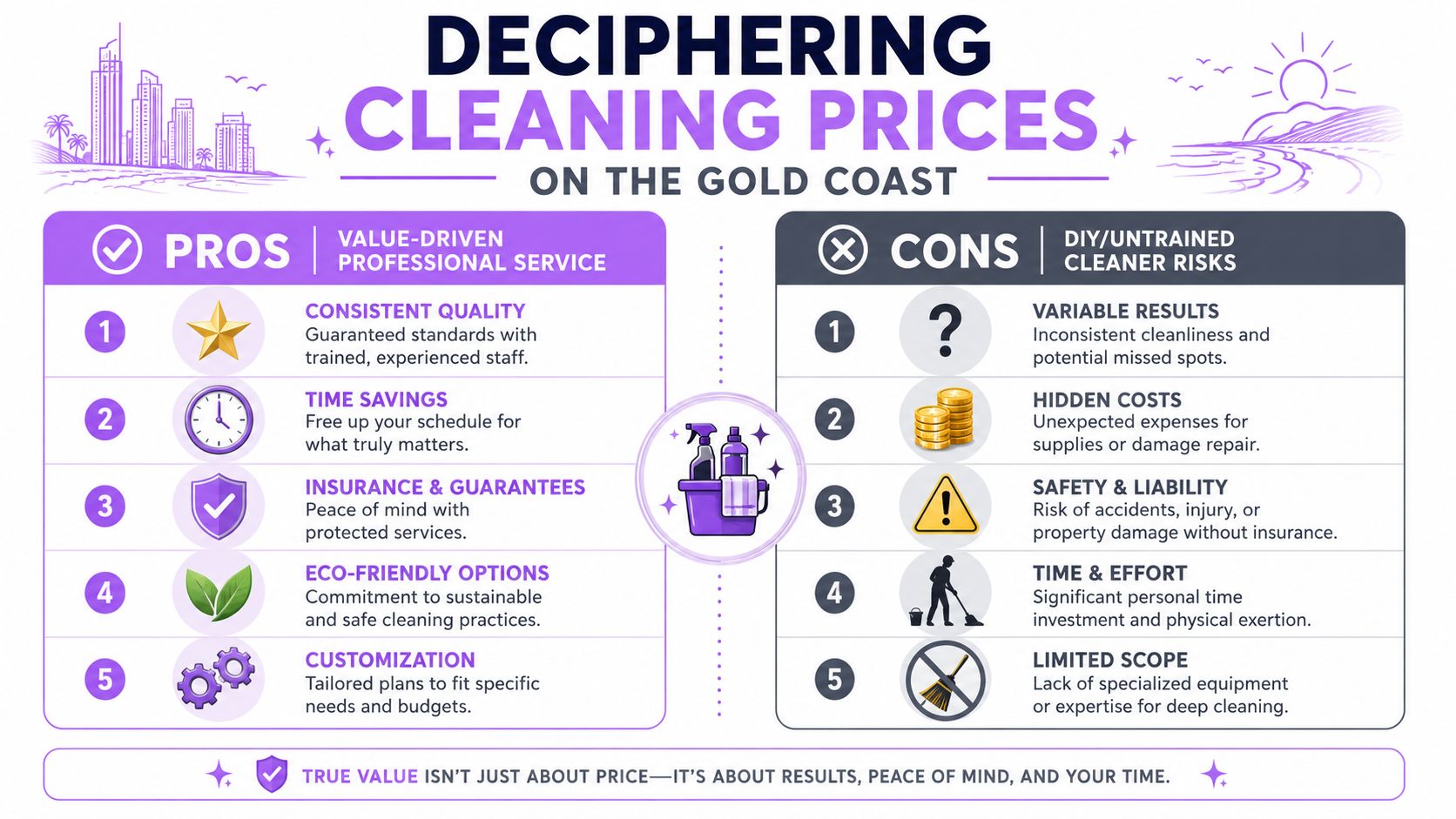
Deciphering Cleaning Prices on the Gold Coast
A two-bedroom apartment in Broadbeach and a weather-exposed family home near the water can both get quoted as a “standard clean.” On paper, the prices may look similar. In practice, they are not the same job.
Price only helps if the scope is clear. On the Gold Coast, salt residue, humidity, sand tracked through entries, and mould-prone wet areas can change the labour required from one suburb to the next. A low quote often misses those local conditions, then recovers the margin by cutting detail, excluding tasks, or charging extras once the cleaner is on site.
What local pricing reveals
Third-party market guides give a rough starting point, not a decision-making shortcut. For example, Maid2Match's Gold Coast cleaning pricing guide lists typical hourly and flat-rate ranges for house cleaning, and notes that extras such as oven cleaning and interior windows commonly sit outside a base service. That lines up with what operators see on the ground. The headline price rarely reflects the full scope unless the quote is written properly.
That is where cheap quotes start to fall apart:
- Basic-only inclusions: The price may cover visible surface work and little else.
- Extra-task pricing: Ovens, fridges, skirting boards, and interior glass are often excluded.
- Open-ended duration: Hourly work can expand fast in humid homes, neglected bathrooms, or properties with pet hair and sand build-up.
- Equipment gaps: Some providers expect the client to supply products, a vacuum, or access to power and water without stating it upfront.
There is also a category issue many customers miss. A standard domestic clean is priced differently from post-construction work, NDIS home cleaning, or a handover clean in a building with lift bookings and strict access windows. If the cleaner prices all of those jobs the same way, the quote is probably not built around the true workload.
Why fixed quotes usually produce better outcomes
Hourly pricing can work for repeat maintenance cleans where the condition is stable and the checklist does not change much.
For larger homes, waterfront properties, builder cleans, and any job with special access, a fixed quote after inspection is safer. It protects both sides. The customer knows what is included, and the operator can allocate enough labour, time, and equipment to finish properly.
A useful quote should cover more than a number:
| Quote item | Why it matters |
|---|---|
| Scope of work | Confirms which rooms, surfaces, and detail tasks are included |
| Add-ons | Prices ovens, fridges, internal windows, and other extras before the day |
| Access conditions | Accounts for parking, keys, lift access, security, and after-hours entry |
| Site condition | Separates routine cleaning from recovery work, mould treatment, or builder dust removal |
| Supplies and equipment | States what the cleaner brings and whether specialist products are needed |
| Timing and labour | Matches the crew size and booking length to the real job |
This matters even more if the property needs a mixed scope over time. Many Gold Coast clients want recurring cleaning, then occasional extras before inspections, guest changeovers, or holiday periods. A structured option such as a custom cleaning bundle for recurring work and add-on tasks is usually easier to manage than re-scoping the job from scratch each visit.
The strongest quote is not the lowest one. It is the one that still holds up once the cleaner sees the property, starts the work, and delivers the result promised.
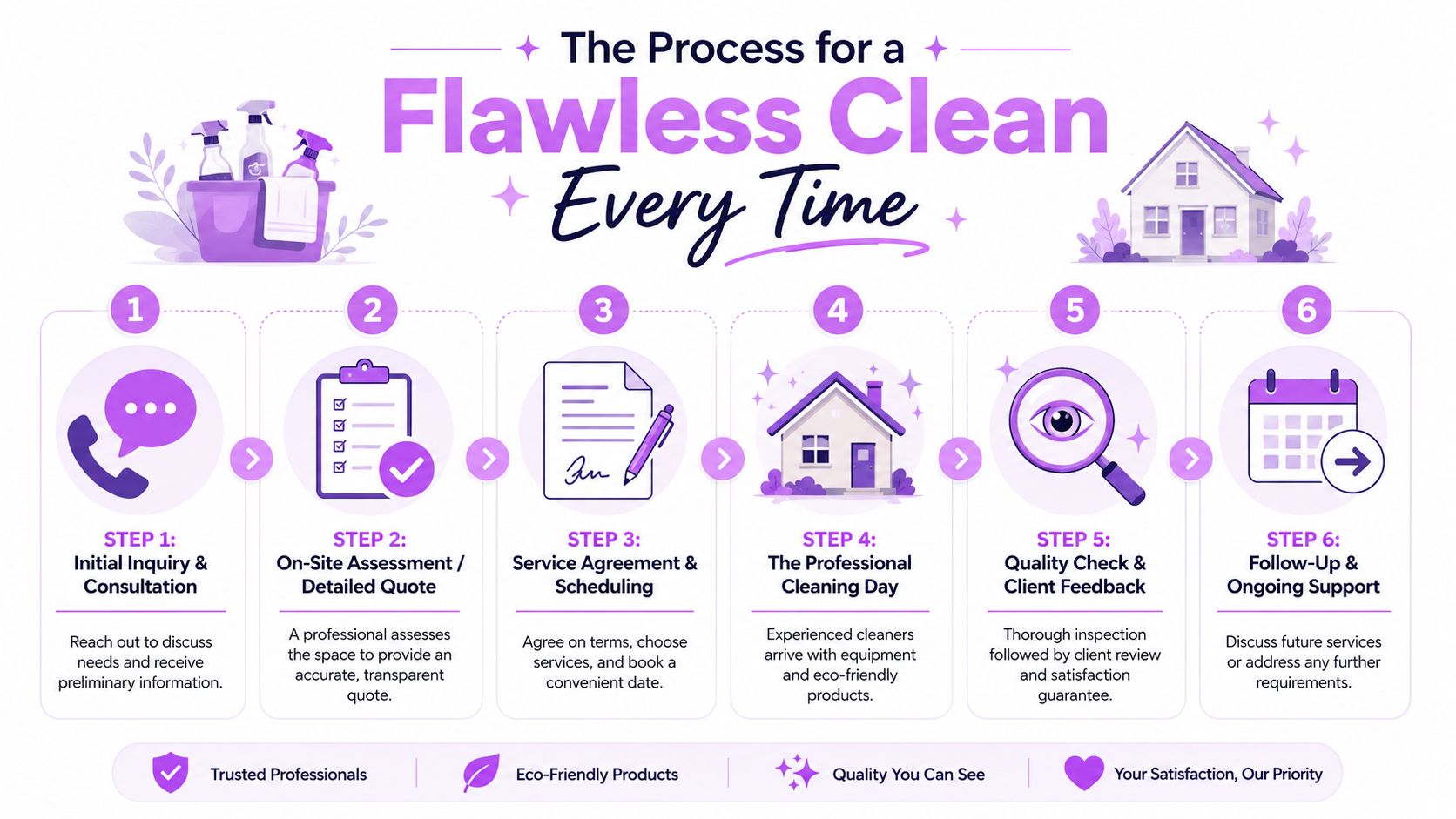
The Process for a Flawless Clean Every Time
A strong cleaning result usually comes from a boringly reliable process. The companies that do this well don't rely on luck, memory, or whoever happened to be available that morning. They use a workflow that reduces ambiguity before the cleaner arrives.
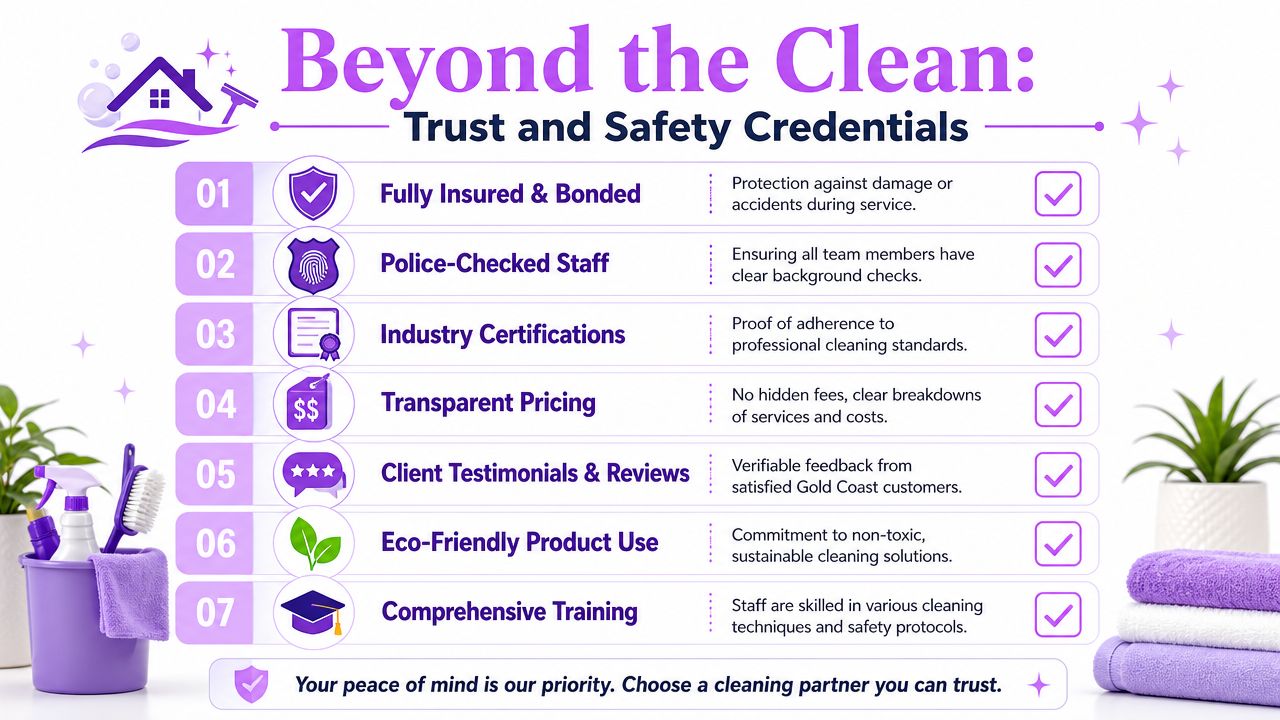
The trust and safety checks below are a useful reference point when comparing providers.
What a professional workflow looks like
A well-run booking tends to follow this order:
Initial enquiry
The business asks the right questions early. Property type, access, condition, service frequency, pets, timing needs, and sensitive areas all affect the job.Assessment and scope confirmation
Complex work should be inspected before pricing is locked in. Hidden variables surface during inspection, such as coastal residue, post-renovation dust, or fragile finishes.Written quote and inclusions
The customer should receive a clear breakdown. Not a casual message with a number and no context.Scheduling and operator matching
The right cleaner matters. A short-stay turnover needs pace and reset discipline. An NDIS home may need communication awareness and consistency. A commercial site may require after-hours access handling.Service delivery with proper equipment
Cleaners should arrive prepared. That means products, tools, and a checklist that matches the agreed work.Follow-up and issue resolution
If something is missed, the provider should have a process for correcting it. A 100% satisfaction guarantee only means something when there is a real support pathway behind it.
Operational benchmark: The best cleaning systems solve confusion before the appointment, not during it.
What usually goes wrong when the process is weak
Problems often start before any cleaning begins. The quote is too broad. The customer assumes extras are included. The cleaner hasn't seen the site. Access details are incomplete. Nobody has confirmed who is bringing equipment.
When that happens, the visit becomes reactive. The operator spends part of the booking figuring things out instead of cleaning. Quality drops because the time is being consumed by uncertainty.
A better model sets expectations in advance and sends safety-checked operators who fit the job. That's why reliability is not just about punctuality. It's also about whether the business can repeat the same standard without constant supervision.
For homeowners and property managers, the simplest test is this: can the company explain its process from enquiry through follow-up in plain language? If it can't, there's a fair chance the actual service will feel just as loose.
Beyond the Clean Trust and Safety Credentials
A cleaner is entering someone's home, office, tenancy, or worksite. That makes trust a practical requirement, not a branding phrase. The safest choice is usually a real operating business with documented systems, insured work, and screened operators rather than an informal arrangement built on convenience alone.
That becomes even more important when the site is public-facing, vulnerable, or high-risk.
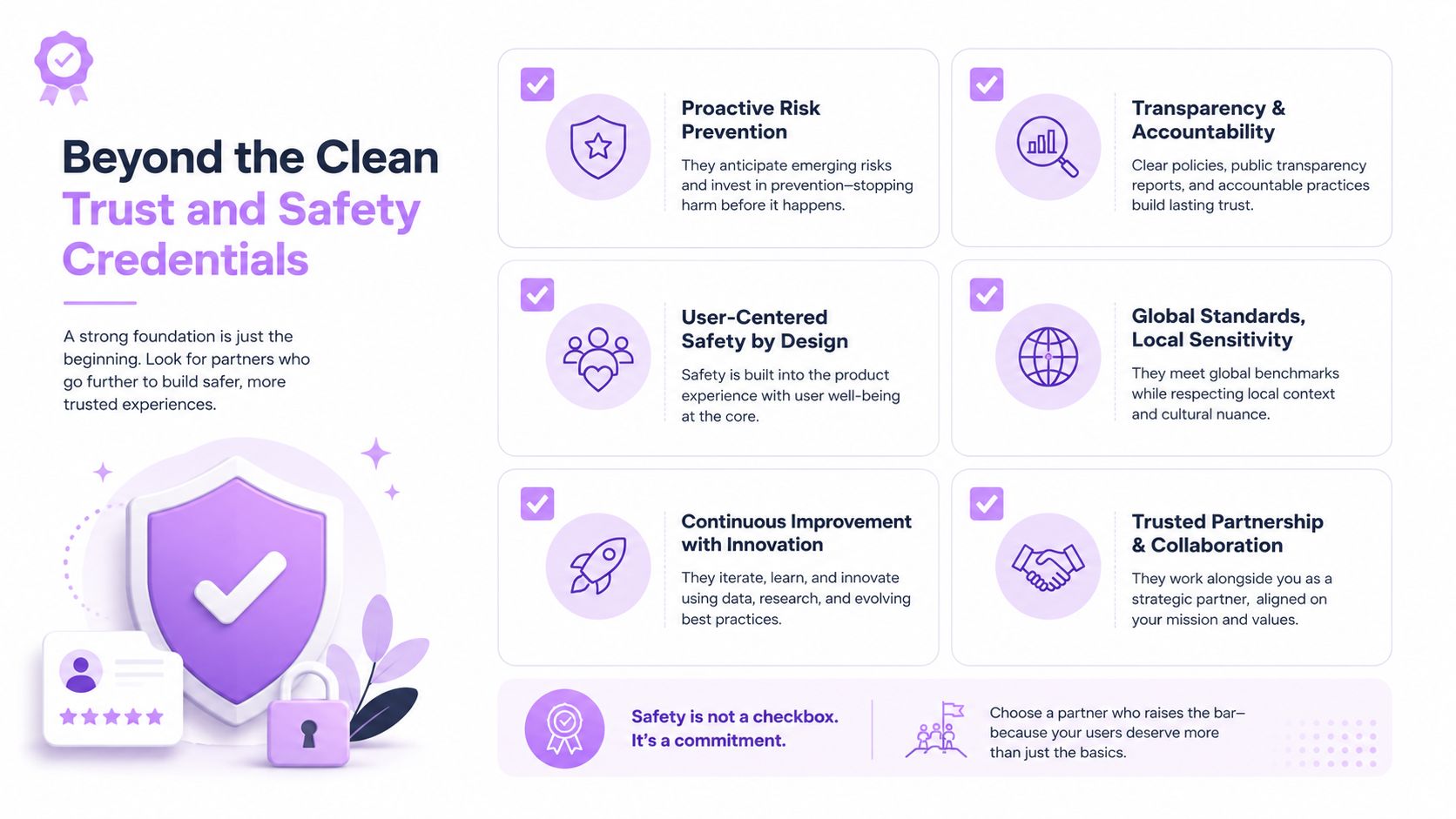
Credentials that matter before booking
Customers don't need a long legal briefing. They do need clear answers on a few core points:
- Insurance: There should be protection in place if accidental damage or an on-site incident occurs.
- Worker vetting: Police-checked or otherwise screened operators matter, especially in homes, schools, NDIS-related settings, and after-hours commercial work.
- Defined supervision: Someone should be accountable for the service if the result isn't right.
- Consistent communication: Booking notes, access instructions, and special requests need to be passed on accurately.
- Documented standards: A checklist beats a verbal promise every time.
Why compliance changes the quality of the job
Under Australian Work Health and Safety frameworks, a cleaning company must manage risks around chemical handling, slips, and manual handling, which requires site-specific plans and trained staff. That's one reason on-site quoting is so important for commercial and more complex work, because hazards need to be identified before the service starts, as outlined in this WHS-focused cleaning operations summary.
This isn't paperwork for its own sake. It affects the actual result.
A team that plans for slip risks in wet areas, chemical suitability, public traffic, and lifting hazards is more likely to clean the site properly without causing damage, disruption, or avoidable safety issues. That's especially relevant for strata, offices, post-construction sites, and jobs with multiple rooms or repeated visits.
Trust isn't built by saying a team is professional. It's built by showing who's coming, what they're doing, how they're covered, and what happens if something goes wrong.
For a cleaning company Gold Coast clients can rely on, safety and transparency should be visible before the first mop hits the floor.
Frequently Asked Questions About Gold Coast Cleaning
Specific questions usually reveal more than a standard quote request. They show whether a provider understands the local environment, whether the scope is being priced fairly, and whether the cleaner is suitable for the kind of property involved.
FAQ Quick Guide
| Question | Answer Summary |
|---|---|
| How do coastal conditions change cleaning requirements | Salt, humidity, sand, and UV exposure increase residue, wear, and rework, so methods and frequency need adjusting |
| What should a Gold Coast cleaning quote include | Scope, add-ons, equipment, supplies, travel, timing conditions, and any surcharge triggers |
| How can someone tell if a cleaner is suitable for NDIS or post-construction work | Check vetting, insurance, communication process, service boundaries, and site-specific planning |
| What helps with mould, grease, and heavy grime between professional visits | Use surface-appropriate, eco-friendly products and avoid harsh mismatched chemicals |
| How often should a property be professionally cleaned | It depends on use, exposure, occupants, and the standard being maintained |
How do coastal conditions change cleaning requirements
Gold Coast properties cop more environmental pressure than inland sites. Salt air settles on glass and metal. Sand is abrasive underfoot. Humidity lingers in bathrooms, laundries, and shaded corners. According to Gold Coast Cleans' overview of coastal cleaning conditions, these factors increase corrosion risk, glass spotting, grout staining, and floor wear, which means service plans should be adjusted by substrate and location rather than room count alone.
That matters in practice. Near the coast, neutral-pH floor care is often a safer choice for regular maintenance. Metal fixtures need corrosion-aware care. Glass needs controlled dwell time and proper detailing instead of over-wetting and smearing residue around.
If a cleaner talks only about “bedrooms and bathrooms” and never asks how close the property is to the water, that's a weak sign.
What should a Gold Coast cleaning quote include
One of the most useful questions a customer can ask is simple: what exactly is included beyond the base rate?
A common consumer problem is opaque pricing, especially when the advertised rate doesn't mention travel, equipment, supplies, weekend surcharges, or how larger homes and short-stay turnover timing affect the total. That's why clear upfront disclosure matters, as highlighted in this discussion of quote transparency and common pricing gaps.
A usable quote should answer these points in writing:
- Core scope: Which rooms and which tasks are included.
- Add-ons: Ovens, fridges, inside cupboards, internal windows, and housekeeping extras.
- Supplies and tools: Whether the cleaner brings everything.
- Access conditions: Parking, keys, lifts, codes, and after-hours entry.
- Timing rules: What happens if the property is in worse condition than described.
- Rescheduling or weekend charges: If they apply, they should be disclosed before booking.
If the quote stays vague, the invoice usually won't.
How can someone tell if a cleaner is suitable for NDIS or post-construction work
These are two very different services, but both require more than a generic domestic pitch.
For NDIS-related cleaning, the provider should be able to explain who attends, how communication is handled, what boundaries apply, and how safety and consistency are managed. The work often happens in homes where routine, respect, and trust matter as much as the cleaning itself.
For post-construction cleaning, the issue is site readiness and technical method. Fine dust, handover pressure, newly installed surfaces, and staged access can all complicate the job. The cleaner needs the right equipment, suitable products, and a checklist that reflects actual builder-clean requirements rather than ordinary house cleaning.
Questions worth asking include:
- Who will be on site
- Are operators safety-checked and insured
- How is the task scope documented
- What happens if the site condition changes
- How are sensitive surfaces or restricted areas handled
A provider that can answer those directly is usually operating at a higher standard.
What helps with mould, grease, and heavy grime between professional visits
The wrong product can create almost as many problems as the dirt. Harsh degreasers on the wrong finish, overly acidic bathroom products, or heavy fragrance products in poorly ventilated spaces can all cause issues.
For common household trouble spots, a safer approach is to keep a small set of surface-appropriate, eco-friendly products on hand:
- For bathroom mould and soap residue: Use a bathroom cleaner suited to tiles, grout, and wet-area surfaces. Let it dwell properly, then rinse and dry the area to reduce moisture hang-on.
- For kitchen grease: Use a quality degreaser designed for cooktops, splashbacks, and rangehood surrounds. Don't overapply on painted or delicate finishes.
- For general upkeep: Microfibre cloths, a neutral cleaner, and a glass product that doesn't leave residue usually cover most in-between maintenance.
For households that want trade-grade options without guessing, the Star Cleaner Shop's eco-friendly cleaning products are one practical source for maintenance supplies and equipment. The main point isn't the brand. It's using the correct chemistry for the surface and problem.
A good product supports technique. It doesn't replace it.
How often should a property be professionally cleaned
There's no single schedule that suits every property. The right frequency depends on how the space is used and what standard the occupant expects to maintain.
A practical way to decide is to look at pressure points:
| Property type or condition | Usually needs |
|---|---|
| Busy family home | Regular maintenance to keep bathrooms, floors, and kitchen build-up under control |
| Short-stay accommodation | Turnover cleaning tied to booking cycles and guest presentation |
| Coastal apartment | More frequent attention to glass, floors, and salt-exposed surfaces |
| Office or shared workspace | Scheduled cleaning based on foot traffic, shared amenities, and presentation needs |
| Property after illness, renovation, or neglect | A reset clean first, then ongoing maintenance |
If the home never seems to catch up, the answer usually isn't a longer standard clean. It's starting with a deeper reset, then moving to a realistic schedule that holds the line.
Your Next Step to a Perfectly Clean Property
The right cleaner isn't just selling time. The right cleaner is reducing uncertainty.
That means clear scope, a quoting method that matches the property, operators who are safety-checked and properly supported, and a service model that doesn't rely on assumptions. On the Gold Coast, it also means understanding local conditions that affect surfaces, moisture, and maintenance frequency.
For households, property managers, and commercial clients, the safest way to compare providers is to look past the advertised rate and ask harder questions. What's included. What isn't. Who attends. How site risks are handled. What happens if the result misses the mark. Businesses that can answer those directly are usually the ones built for consistency.
A cleaning company Gold Coast clients can trust should make the process easier, not murkier. Reliability shows up in the quote, the communication, the arrival, the checklist, and the follow-up. That's the standard worth expecting.
If a property needs a cleaner with transparent quoting, vetted and insured operators, flexible scheduling, and a 100% satisfaction guarantee, Star Cleaner Australia Pty Ltd offers an obligation-free on-site quote so the scope is clear before work begins.